
Planning Sidewalks And Planting Beds (How Big Do Planting Beds Need To Be?)
Since I’m in a holding pattern with my storage room (waiting for my contractor to do the new subfloor and drywall) and with the dining room right now (waiting for drapery fabric to be delivered, waiting for air-dry clay to be delivered, waiting for inspiration to hit for the gallery wall and new benches, etc.), I decided to head outside yesterday and start marking out the walkways and planting beds for the front of the house so that I could get a visual of what these might look like in our actual yard.
I started with my landscape design as a reference. On the landscape design, the designer has the walkways coming off of the front sidewalk covering the curved area of the main sidewalk.
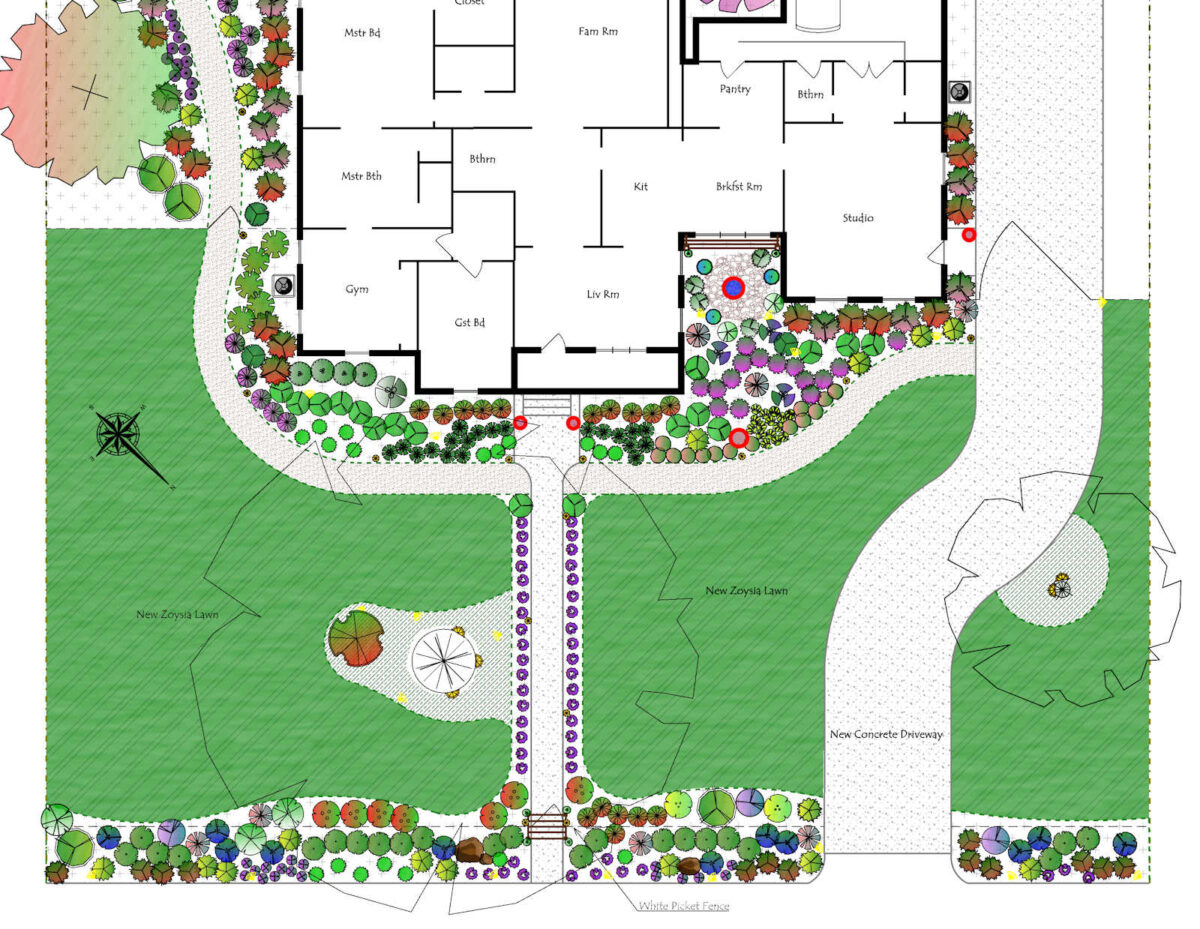
I had always envisioned those gentle curves continuing and veering off into the side walkways. But when I marked that off, I didn’t really like it.

So instead of trying to continue the curve, I ended up coming straight off of that point where the curve meets the corner on the sidewalk. I liked that look much better.

But one thing I’m still not sure about is the placement of the walkways. Here’s a closer view of how the designer arranged the walkways coming off of the sidewalk. You can see that the walkways connect at the curve.
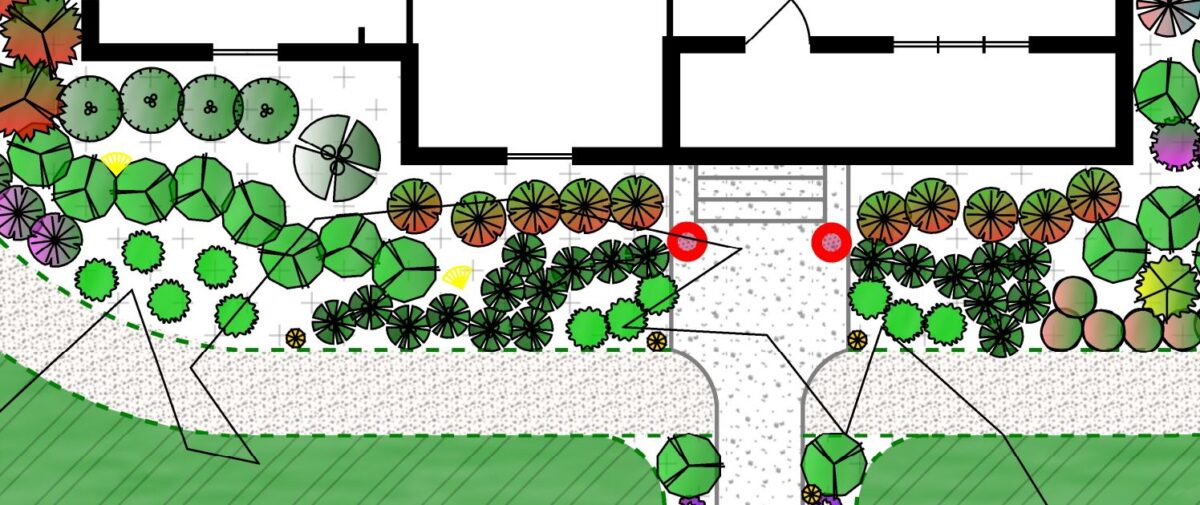
I don’t dislike that, but the issue is that if I go with that plan, that gives me a planting bed in front of the porch with a depth of about nine feet. That seems like a really deep planting bed to me.

If I go the opposite direction with the walkway, that gives me a planting bed that is about five feet deep. That seems more manageable to me.

But I don’t have any experience with planting beds, so I’d love your input. Larger planting beds means less yard/grass to take care of, and I do like that idea. But nine feet just seems extreme to me.

I’ve enhanced my paint lines in some of these pictures so that you can see them better. Hopefully you can see this one with just the paint lines so that you can see how the walkway would curve around the area in front of the breakfast room windows.

And then I would have another five-foot-deep (or nine-foot-deep) planting bed in front of the studio, depending on if I keep the walkway where it’s marked off now or move it towards the street like the designer shows on the landscape plan.

If I go with the five-foot depth, the walkway coming off the sidewalk would look like this as you’re approaching the front door.

And the other side is where it gets tricky. If I stick with that five-foot depth for the planting beds in front of the front porch and my walk-in closet window, the pad that is poured for the steps to the bedroom would look something like this so that it meets the walkway. Keep in mind that I’m limited in the width because of the cleanout for the sewer line and the gas meter.

Just a note: The walkway won’t dead end at the end of the house. It will curve around to the side of the house, but I ran out of spray paint and daylight, so I stopped at the end of the house.
If I go with the nine-foot depth for the planting beds, that pad for the steps ridiculously long. It’s very hard to tell if this would actually look awkward or if it would look nice. With it just being orange lines, it looks crazy to me. But I’m sure once it’s done, and there’s just concrete and no orange lines, it would just look like a normal walkway leading to some steps and a door. It’s just hard for me to picture in my mind.

So at this point, I’m leaning towards the walkways being closer to the house and having five-foot-deep planting beds in front of the porch and my walk-in closet window. But I could certainly be persuaded to move to closer to the street, just like the landscape designer planned, if you experienced gardeners think that it’s better to have the planting beds nine feet deep instead of five feet deep. Or maybe the decision doesn’t depend on the depth of the planting beds. Maybe it would just look better to start the walkways in the curve of the sidewalk instead of after the curve. So if that’s the case, you can let me know what you think.
More About Our House Exterior & Yard
see all exterior &
yard diy projects
read all exterior &
yard blog posts

Addicted 2 Decorating is where I share my DIY and decorating journey as I remodel and decorate the 1948 fixer upper that my husband, Matt, and I bought in 2013. Matt has M.S. and is unable to do physical work, so I do the majority of the work on the house by myself. You can learn more about me here.
Hi Kristy. I think the depth of your planting beds depends on what you want to put in them. If you put some bushes that will get larger, I think they would fit nicely in a 9′ bed. They may start out small but after about 3 years they may be remarkably larger! If you are only thinking of flowers, then I think the 5′ depth would be plenty. My vote is larger with some flowering bushes. I have hydrangeas but not sure what would do well in your zone. Good luck.
I agree with Suzanne. We were new to gardening when we bought our house. We started with 4 ft beds which seemed HUGE at the time. But then we quickly realized that it didn’t give the foundation or the bushes any room to breath as they got larger. We’ve expanded the width of our beds twice and we’re loving the extra room. The bushes have room to get larger and not expand over the sidewalk or push up against the foundation, and we have some room to infill with fun annuals or other plants.
I would vote for smaller planting beds. I feel like weeding and maintaining planting beds takes a lot more work than just mowing grass, And that’s a lot of planting bed space to keep on top of! I think the plan is beautiful, but time and reality have to be taken into consideration 😆
What she said. You can use weed barrier, but they’ll find a way through -Texas weeds are strong. And mowing in the area (even with a sidewalk) will start grass growing in your planters. And the amount of mulch to try to prevent that ……
This is what I came here to say. Even using the weed protector, you will still deal with weeds, pruning, etc. I would much rather have small beds and more lawn to mow.
I absolutely agree with these comments about weeds, etc. I live in the Dallas area, so not too different from your conditions. After a summer like we have had this year, I am seriously thinking about removing a couple of beds I had started in my back yard and turning them back to grass. I have a number of large shade trees, so fairly shady much of the day until 4:00 or so. That sun can be brutal at that time of day, and beds with flowering shrubs (particularly hydrangeas) will require constant watering, but we have plenty of weeds that thrive on heat and dry! It appears that I have more shade than most of your yard, so this comparison may not be worth much, but I only have to water my St. Augustine lawn once a week when it gets this hot. But most of the beds even with shrubs that are fairly heat tolerant really need watered at least 2 times a week. I am definitely becoming a believer that maintaining and mowing a lawn is much less time and water consuming. You obviously will want beds as you are describing, but I would definitely start with the smaller size in this part of Texas.
Larger planting beds means more weeds to pull and control. Suzanne’s comment makes some good points. Mowing is easier than weeding. Good luck!
We have deep bed. The bushes take up a lot of room. The deeper beds would work better. You can still plant flowers. But the bushes will be the backbone of your beds.
I second this. Shrubbery will fill in and choke out 95% of weeds under them. They will offer year round greenery. The space in front depends on your level of gardening interest. You can work to establish perennials to enjoy year after year, plan and plant annuals as the seasons change, or do a mix of both.
The 9 feet give the bushes room to grow without growing onto your side walk. Perhaps check on the plants that are depicted in your garden map. You may find that they need the space for growth. Just like remodeling gardening gets uglier before it gets beautiful! Lol
Sheila F.
The older I get the less annuals I plant. I do think they’re lovely in a more narrow bed but the yearly expense of them is something I’m starting to get away from. Although perennials are expensive it’s many times one expense. They do require some maintenance but it’s not too bad. I think you need the larger bed if you do perennials. I don’t think the longer walkway looks odd either.
Im by no means an experienced gardener, but one thing I have noticed is non- experienced gardeners doing is not allowing room for plant growth and whatever else is in that space, for you, walkways and in particular room for Matt’s wheelchair. Just an FYI, I have never had a plant follow the growth charts on the tag. This is fine, but consider what maintenance it will take to keep the paths clear if the plants over shoot the growth pattern and how close you planted to the path. Are you planning to plant the suggestions? Obviously, those plants are filling in the nine foot space. Cutting that space in half, that planting arrangement would change.
I plan to follow it generally, but I think there are way too many plants on the landscape plan. I like a little breathing room in a planting bed for some pretty, large rocks and other interesting things. I don’t want my beds jam packed with plants.
Hi,
I love your 5 feet deep idea better. I would add curves to the little path that goes to your bedroom door instead of straight. I would add a path where the dinning room window is for the seating area, with the same curves as the bedroom one, that will join to the main path. I don’t know if it makes sense…
I also like the idea of some curves in the left side of the house going toward the bedroom.
Look at the mature widths of the plants you’ll be using. That will determine the size needed for your planting beds.
Why don’t you go to a garden center and look at some of these plants on your plan and talk to a gardener there? It looks like you have some shrubs and even a small tree. It is easy when it is empty to think it is big but once you put some plants in there, they may be going over the sidewalk at their mature with. You want some structural and some things that bloom seasonally. That means shrubs.
Rather than use the fabric to deter weeds growing, I’ve had a great deal of success with several layers of newspaper. It’s cheaper and better for the soil.
Ah, yes, reminds me of the book Lasagna gardening! Newspapers decomposing encourages worms, a gardener’s best friend.
If I had stayed I’m my Ohio house, I was going to start a worm farm in my basement. Best soil there is😉
((Now that we’re in Az, I miss all the Midwest plantings I had. There’s not much that grows here that’s non-native.))
Yes. I put down cardboard. Soil goes on top. The cardboard eventually breaks down but in the meantime it smothers the weeds.
Also, I know Texas is not California, at least not the part of Texas that is east of the 100th meridian, but with our recent fires, insurance companies are starting to refuse to renew policies where foundation plants and trees are too close to the house. They want 5’ of “defensible space) around the foundation. Also trees planted too close to the house provide access to your attic for rats and squirrels. Personally, I’d go with 9’ beds. Plant shrubs in the back. Then some perennials and fill in with annuals. I’m planting California natives at my house because I want to attract butterflies, native bees, and other pollinators as well as birds. We have a great database called calscape that lists all kinds of native plants that grow in our vastly varied biomes. You put in your address and it will return a list of recommended natives. My ultimate goal is a xeriscaped fire-resistant garden of natives.
I’m team larger beds. Someone once told me that the key is larger, mounded beds. I started paying attention and noticed that the homes that had really invested in landscaping (whether they did it themselves or hired the work) used larger beds and mounding inside the beds.
One thing to remember is that it’s best to keep some distance between the plantings and your house. I have not done that, but know I need to. So that would use up some of your space. I think the space is good not only to reduce pest pressure, but also breathing room for the plants. Air circulation is good for their health, but it also looks good. You could think of a bush next to your home in the same way that shoving a sofa against a wall is not recommended by interior decorators.
My only input is 1. Make the beds wide enough that you can leave plenty of room between your foundation and the plants, and 2. before you pour the paths, put a conduit underneath, so you can run water or power under the walkway without having to damage the concrete.
Lots of yard work exp here. When putting in garden beds consider what plants you’ll use, how much they’ll cost when thinking of the size of the beds. First glance, those big beds look like they’re going to cost a fortune to put in. It’ll take awhile for them to fill in as well. Please check this all out before jumping in the deep bed of the pool!
Contact your landscape designer and ask him to send you elevations of the front of your house, so you can see what these trees, shrubs, and plants will look like when fully grown in and mature. This will give your the viewpoint you need to decide.
If you go with the smaller planting beds, you will need to change the planting plan. You will not believe how big some of those shrubs will get!
If your designer can’t give you an elevation, feed the info into ChatGPT. It will give you an approximation.
Hi Kristi,
I just went out to measure one of my garden beds. I wish I could figure out how to send you a picture of it. The bed has 2 hydrangeas in the back, several pots of flowers in the middle and coral bells along the front edge. There are a few other perennials in the bed too. My bed is 12 feet deep.
Has your landscape designer put some bushes for year round interest in the beds? I find that bushes take up more visual and actual space in a bed. When I originally planted my beds, I packed in more plants than I now have. After a few years, I needed to thin things out or there were too many plants.
When you do start planting, think of a 3 year plan……..the 1st year the plants sleep, the 2nd year they creep and the 3rd year they leap. Its just a silly rhyme to help me remember not to plant things too close together and to try to be patient! At first your beds will look puny, but it’s okay.
So my recommendation would be to have 9 foot beds. Good luck!
Excellent recommendations!
Wow!! Twelve feet? All of this is very helpful info.
Ditto to what this guy says! 😉
My beds in the front places are 7 feet, maybe more. You want 1-2 feet behind plants by the house so there’s circulation and room to move behind. 9” good for shrubs but 5” fine for very little shrubs and flowers. Room to grow is important. Don’t crowd it and use native plants where you can and definitely no invasives. Plants that colonize will fill the space thick but maybe you don’t want that. I put a thick layer of mulch and weed only a little and only water the container plant. Start with less. Sometimes plants will drop seeds and you’ll get more plants. Re the sidewalk, instead of have the walk from the BR butt into the other walk, maybe that corner can be curved. If you just want small plants, no shrubs, 5” will do. But it will be more like 4” planting space. The 9” bed might be more like 7”, allowing for the back access. It isn’t good for the house to have plants smushed up to it and I see that all the time where planting beds were made way too small.
Many shrubs grow to be 3-5′ around, filling a 5′ bed with no room for flowers. I say this as a gal who planted a twig of a $9 Japanese maple from Aldi in 2018 that’s 5′ across now, and threatening a narrow walkway, and a few small 1 qt frost proof gardenias in 2021 are now are 3′ across with room to grow.
So look at the plants they show. Varieties of what the plan says, can differ to what you find locally. If your yard has a ton of water, they’ll grow bigger or not thrive. Decide if you like them, them look at their mature size, then height. Many plants have smaller and bigger varieties, and you can get lost finding the right variety like a paint color.
Establish flashcards on what was called out, take notes (stay/revise/no, plan size, local height/width) so you have the notes all together. You ignore certain plants to have a narrower bed. On rainy days research, water needs, and sun/shade how to fill it in.
For working out paths visually, Try a stiff bright hose (or pool noodle), stiffer ones smooths out curves well, and show in pictures easier. Then when good lay stakes for straight lines paint the curves.
Hey Kristi,
I think you will hear the same thing over and over. It 100% depends on what you are planting and the expected size of the plant!
9′ gives you room for a nice full bush in back most types hit 4-6′ diameter even on the little ones eventually.
Allowing for layers and texture and depth, and color. I think you will appreciate the space once you get into the actual plants.
I know it is especially hard when planting the little babies, but the spacing is there because they will fill it in!
Have you walked around a nursery with your plans in hand and evaluated any of the suggested plants in person?
It would be very eye opening for you I think to get things planted and see what they look like a year later. 🤯
Can’t wait to see!
I have tried once going to look at plants with my plan/list in hand, but I made the mistake of going to Home Depot instead of a local nursery. So no one could really help me, and I ended up getting overwhelmed and leaving empty handed. I get overwhelmed with this very easily because I know absolutely nothing about plants. I feel so out of my element. I need to try again at a local nursery where the people will know a lot more and will be able to actually help me and answer my questions.
Consider joining your local gardening club. It’ll be full of knowledgeable people, and our local membership gets discounts at the local garden center on things that are growing. I make my membership back every year in discounts on my purchases, which doesn’t even include the value in the monthly presentations our club books, or the garden tours for all levels of garden.
Talking to a master gardener is good too. Contact your local university extension.
I agree you need visuals and should go to landscape designers and architect websites to see why your design calls for 9’ deep. Your yard is deep and plants will get swallowed and not look balanced in relation to the grass and trees. Deborah Silver and Co is a favorite of mine.
WOW!!! I just went to Deborah Silver’s website and it is AMAZING!! So much inspiration there!
I would definitely go for the 9 foot flower beds. I don’t know if you still follow Laura from Garden Answer (thank you for introducing me to her videos several years ago!), but I’m sure she would also suggest going larger than 5 feet. You can always layer plantings in that space (taller in back, shortest in front), and the more plants you have that “meet”, the less weeds you will have overall once they are established. I DO NOT recommend rock as your mulch. I live in Illinois and my flower beds with rock bake my plants and we have to constantly watch them in the heat. I can’t imagine having rocks as mulch in Texas. My beds with regular mulch are much happier. Five feet seems deep, but that space will fill in very quickly as shrubs/plants mature.
As far as the walkway to your bedroom door, you can choose your plants for that area to draw the eye away from the sidewalk leading up to your door. Adding visual interest away from that area will be key. I’m excited to watch this next chapter for your home evolve!
I am a Master Gardener with 30 years of experience in multiple states…I really encourage you to follow your landscape designer’s plan and start small!!! Two beds at a time in your most prominent area for enjoyment and visibility will make it seem less like work and more like fun! All the readers saying look at max growth are right! A wee potted plant can get quite big with proper conditions. Look online for your county extension service-they should have tons of info on how to amend soil, what grows well, native plants, etc etc etc. Don’t take on too much as getting things established takes time and effort. Mulch is your friend to keep weeds down and moisture at root level. Good luck and hope you enjoy it!!!!
Celine,you made me think of something else; the Extention Service might do soil testing too. It’s looked pretty dead since nothing has been there for years. Once tested you can get a better idea how to amend it.
There’s a ton of great advice in these comments.
Well Kristi… curved paths & pant beds…have always been my choice…they seem perhaps harder to mow around, but a grass side boarder placed just inside of the outer edge of the plant bed, perhaps of flat side up bricks …again just inside the edge of the plant bed… leaves a perfect place for the one of side wheels of the mower to rest on and NO ADDITONAL POST MOWING TRIMING would be necessary!
It depends on what you want to plant and how much work you want to do to maintain them. I have beds of varying sizes but most are definitely no deeper than 5 feet. I have some smaller bushes in the back and then lower height flowering plants in the front. In TX, that might be azaleas and ti plants and daisies or begonias. If you don’t want to regularly trim or shape bushes, a narrower bed would be better. I have just roses in a bed that’s about two feet deep along my front fence and that’s perfect for that one. My deep bed has a mix of bushes, ferns, and hostas (I’m in Oregon).
For the sidewalk, I am bothered by the shape with the side walkway not meeting the curve. I’m wondering how it would look to either have the sidewalk start wider at the connection point and then narrow or to have it connect in two places then meet and use the little space between the connections as a defined planting bed for a single plant or planter.
Hi Kristi,
I have 2 thoughts. First about the plants being close to the house. I was told that for fire and also for painting you should always be able to walk next to the house. Second, as far as your sidewalks would you be curving it at your junction locations for easier wheel chair turns?
Also, I have stepping stones right off of my front door steps, they are okay but one day I will move them out so it won’t feel like a sudden turn coming down the steps. I have 3 steps.
There are pros and cons for each plan. Looking at the photos with orange markings, it doesn’t appear there’s 5′ of space between the porch and proposed walkway but I trust you measured it. That depth would to be enough space for planting one shrub between the porch and the walkway and also between the walkway and closet/laundry. This may look a bit stiff, like a row of soldiers lined up. If you could find pots from shrubs or something similar and place them in front of your porch you may get a better feel for how it will look. Our garage extends from the front of our house. There’s a walkway from the driveway to the front porch which created a landscape bed approximately 14′ x 14′. There are 17 shrubs planted there along with 3 large rocks and a metal armillary sculpture with wood mulch. On the other side of the porch there’s a bed about 17′ wide at the house curving down to 10′ wide where it meets the walkway. It’s about 10′ deep at the corner of the house and 20′ deep along the walkway. I am guessing there are about 27 shrubs and 2 trees along with an area for annuals. I like the look of the deep landscape beds but it does take some work trimming the shrubs, replacing the mulch every two years (8 cubic yards including the beds along the sides and backyard of the house) and occasionally weeding.
Your beds are way to close to the house for someone living in termite country. I wouldn’t plant anything or put mulch within 2-3 feet of the house. I know it seems like a lot but when you do foundation plantings, they’ll grow to fill in a lot of the space but leave enough so the plants don’t contact the house and you can get behind them to prune. I have a 24″ rock bed next to my foundation and the first bush is planted 3 ft out. I live in a brick house on slab, not a post and beam. You should look at the landscape designer’s plans as well as talk to people at your local nursery (and I don’t mean Home Depot) to get some ideas. It doesn’t look like you have gutters so think about bushes that aren’t highly susceptible to fungus. What size and height do you want your foundation plants? Do you want to keep the ones in front of the porch/windows low? If so, don’t plant bushes that grow to 8-10 ft or you’ll spend a lot of time pruning to keep them small; ditto for shaped plants like boxwood. Once you’ve figured out your foundation plants and what their eventual size will be, you can fill in with perennials and annuals and that will help you determine the best depth of the beds. Don’t forget that not all perennials are small; evergreen daylilies (don’t use any dormant varieties, it’s not cold enough in Waco), agapanthus, garden phlox etc. are fairly tall and can spread. You also need to consider what’s getting hot afternoon summer sun vs shade. I tracked the sun at my new house this summer to know what I could plant where this fall that won’t be killed off next July. When you have decided what you want and where, you can design your irrigation system for it. There are plants like hollies and liriope that do okay without it but pretty flowering plants generally don’t. I’ll finish by saying don’t put your sidewalks in until you have your beds figured out. Beds can grow or shrink, sidewalks are limiting and expensive to move.
Knowing your sun/shade patterns in different seasons is also a key factor.
I’d also deal with a reputable nursery for the more expensive foundation plants or shrubs and use Home Depot/Lowes for annuals or less expensive ones. And ask the nursery staff if they have at least a year guarantee.
If not I’d go elsewhere.
The landscape designer probably included a list identifying the various plants in his/her design. The design was not cheap and should have recommended plants for your area. I highly recommend using the suggested plants. Take the design and the list with you to your local nurseries to see the recommended plants and get current prices at several. I’m not recommending them, but in the past, Home Depot offered a one year return policy on dead plants; just something to consider since plants are expensive.
It will remain hot (and possibly dry) in Waco until November. Don’t plan on planting anything until then; in the meantime, get the necessary soil and compost brought in and the beds built. Those two alone are more expensive than most of us initially estimate, and will take several days minimum to accomplish. I’m located in Montgomery, Tx so our climates are similar and I speak from experience.
My first impulse was smaller beds, but as I read the other comments and thought of my own beds, I realized you will be happier with the deeper beds, following the design you already have in hand. Try to stick to as many of the recommended plants as possible. I used a designer with different plants, and they failed for various reasons. The nursery had no guarantee on the plants so I was out hundreds of dollars.
My vote is 9′ beds. You would be surprised how large even a dwarf variety can get. I planted some “dwarf” loropetalum shrubs and they quickly outgrew the area they are planted in. It is possible they were mislabeled. I used an extension cord to lay out my flower beds. That way you can change the curves as much as you want to. Also the suggestion about conduit is spot on. You don’t want standing water near your foundation.
Day late but I love the mirror to replace tv. Art would compete with your shelves you love
I think a 9 foot planting bed is a lot and just more upkeep. 5 seems more pleasing to my eye.
Listen to the Master Gardner! Follow your plan, you hired him for his expertise. When you start planting they will seem small and beds will look empty do not give into the urge to plant more!
The primary landing may look better with a slight swoop meeting the sidewalk
I don’t know enough to help with landscaping but are uou putting in an ungrounded watering system or planning gon watering it by hand.
Here’s my 2 cents from decades of gardening. Compost, compost, compost. It is your friend. You can never have enough of it. Keep adding compost as your mulch. Don’t use rock as mulch, and don’t use a plastic weed barrier. Consider having your front walkway widened to be the same width as the concrete by the front steps, removing those odd curves. Pathways should be at least 4 feet wide for 2 people to walk side-by-side comfortably (and when they’re a little wider it’s OK if plants overlap them to soften the edges). Do you plan on using those lateral pathways very often, or are they there primarily to be a border between beds and lawn? Concrete does not need to separate beds & lawn, and paths can be placed inside both beds and lawn! Define their purpose first. Your design plan looks very ambitious, but really ask yourself, “How much gardening have I done in the time I have lived here?” Plants are expensive and your soil seems unhealthy (sorry, it does). You might want to consider sewing the entire area in crimson clover to loosen the soil, add nutrients, and smother weeds which might pop up when the weather cools. Mow it down after blooming and before new seed sets, then till it under with a nice layer of compost on top. Your garden will thank you.
I’d say trust your landscape designer. You paid for their expertise, use it. The smaller beds don’t leave enough room to layer your plants. Layering is what gives a full lush feel. Smaller beds look very flat and lack that designer look. Since you don’t have any experience and lack experience,Trust the professional!
I have a few thoughts! First, you will spend 75% of the landscape budget on soil amendment, compost and good soil, and 25% of the budget on actual plants. I know that sounds crazy but it will guarantee a more successful planting in the beds that haven’t seen nutrients for a long time. Second, the sidewalks would look less harsh initiating from the curved areas. Third, the foundation plants should ideally be some sort of evergreen so you have year round softness. The distance between the plants at full maturity size and the foundation of the house should be 1/2 to 1 foot away from the house. This means some shrubs need to be planted 2-4 feet from your foundation at time of planting. If using 5 feet for depth the beds will eventually look too small.
Fourth, and I don’t think anyone has discussed the actual size of your front yard. While either sized beds would look beautiful, the scale of the beds to the house and how it relates to the size of the yard has been considered when the professional landscaper created your plans. I would recommend the bed sizes on the plans. You can always add or remove dirt but wait until after planting prior to adding a permanent sidewalk. As a side, large rocks and other hardscape look stunning in landscape!
Wider beds are better bushes do grow quickly, and you have to have room to even work in those areas to plant a few annuals or trim bushes. You are in the planning stage but once concrete is poured your design is set. The idea of putting a conduit under the sidewalk for sprinklers in the planting beds is wise, then you are not outside watering the plants all of the time. Someone suggested a concrete path to the seating area, but you could use flag stones or even pea gravel for that area to see if a concrete path is even necessary.
I left my comment on your Facebook post, but I will add here that the walkway needs to come off the curved space, as he’s shown, because you really wouldn’t have enough room for plants (shrubbery) in front of the porch. Even the smallest Boxwoods will grow to minimum 2 feet, and you need to leave room between them and the porch in order to do any maintenance to them or the porch. The beds may look large, but he has a lot of plantings, various sizes that will need room to grow. I always have to fight with my husband when it comes to plantings. He wants 3-4 ft, away from the house, but it doesn’t work with the plants I want! I gave in to him, and now he complains that the shrubs are too big and wants me to scalp them! Give them room to grow according to their tags, and don’t design the beds until you’ve checked out the plants MATURITY that you want to buy!
Spot on advice! Always take into consideration the mature height of anything you plant.
I don’t know if you plan on planting your beds exactly like the paper plan, but were it me, I’d want more breathing room between plantings. This gives you someplace to walk and the eye to rest. It could be mulch, a curvy dry river rock bed, or pea gravel. So a larger bed is not a bad thing.
I always had a cutting garden too which you might want to put in the back; they can get leggy and not as esthetically pleasing to the eye. I didn’t care so much about that, I needed the extra sun the backyard got for them.
Five feet is plenty deep for a nice border bed in front of your house. Especially with as much frontage as you have. When considering 5′ vs. 9′, the most important question you need to ask yourself is how much time can you realistically dedicate each week to keeping the beds maintained (deadheaded, weeded, watered, etc)? As for the walkway/pad from the bedroom door, adding a little flare at the end of the pad where it meets the pathway in front of the house might make it look more substantial. It will also add some nice curves to otherwise straight lines.
Any size you want them to be! And they can change over time.
Your orange idea looks better than the landscaper’s plan. A 9-foot flowerbed is crazy, it looks good on paper, but in reality, not so much. Even a 5 ft flowerbed is large. We had a country home with a 90 ft by 5 ft bed across the front yard. That was so much to take care of. I’m think about a 3 ft bed that you can easily maintain…seriously. Your curve going to the studio looks very good. Instead of all that space by the breakfast room windows as flowers, make a small patio to put that chair on with some pretty outdoor fabric pillows. No water feature, Kristi. That way you don’t have so much flowerbed to maintain. Trust me, mowing the grass up the to edge of the bed is less work that pulling weeds out of the bed. If you have a sprinkler system put in you will have nice deep green grass and the front yard will be beautiful. A bed around the big tree would look nice. A narrow bed on the other side of the house will look fine up to the steps by the door. I’d have a “landing” and a ramp poured instead of steps.
When i lived up north I used to buy all my spring plants at home depot. They were healthy plants
Then we moved to hot Florida and plants are different here
Also they have less plant choices
You can use there web sight looking for plants. They have
Choices I am lookinh for
.and.best of all they deliver to your home for free.
Plants are very healthy. Hope this works in your state.
I agree with all the comments about 9 foot beds. Listen to the Master Gardener comment. Please do not use fabric weed barrier. It’s so unhealthy for your plants and the weeds grow right through it. Your mulch needs to be very thick. Although it’s expensive, you won’t regret it in your hot Texas heat. Follow the advice of the conduit under the sidewalk. There’s an old saying amongst gardeners, “ if you’ve got weeds, you don’t have enough plants”
I’m sure its just me, but big planter beds to me means lots more shrubs and things to have to trim, more mulching… more weeds to keep under control. Yeah, it all looks pretty in a picture, but I had to stop all that when my shoulders got bad. I am amazed at the HGTV show where they go in and redo a forgotten lawn that the person can’t take care of… and then proceed to plant 200 plants!! I don’t know of anything that requires no care. Someone please correct me if I am wrong…because I have had to let my planting beds go back to grass. I’m sure whatever you decide it will be beautiful.
Martha, many shrubs require minimal work. People seem to think they need to go out and trim something which shows they are now “gardening.” I think the first thing Kristi needs to decide is if she is landscaping or gardening. Landscaping in most people’s eyes is a one and done thing – like painting a room. Gardening is an ongoing activity. Those that are advocating shallow beds probably don’t enjoy “yard work.” Deeper beds are craved by those of us who enjoy the journey. Deep beds, gently meandering paths, compost, seasonal change, excitement with new varieties old favorites – those are the delights of true gardeners. To us it’s not yard work, it’s our hobby (and passion).
Shrubs? Deep bed
No Shrubs? 4-5 feet will work.
Remember you don’t want shrubs that will rub against the siding — they need to be placed a distance from the house.
Do a lot of research on the plants suggested for the plan you were given. Do not plant variegated privets, regular nandina (dwarf varieties are fine), or wax leaf ligustrum unless you want to spend a lot of time pruning. Nine foot beds will require a lot of maintenance and will look rather bare for the first few years. As others have said, don’t use landscape fabric or you’ll want to rip it out when grass and weeds start creeping under it and popping through. Maybe start with smaller beds and if you don’t mind the maintenance you can always increase the size.
Personally, I like the little jog in the side walk on the studio side. Don’t forget, those flower beds have to be maintained. Mowing grass is easier.
Now, on the bedroom side, It looks like you might have enough room coming off the door to pour a concrete ramp for Matt’s chair. Then have small beds on either side of it.
The only thing I hope you don’t do is plant a tree anywhere near those sidewalks! Ask me how I know! Dogwoods are pretty decent about not screwing up concrete. Please do some deep research on what type of trees could be used in your yard. Once the concrete starts lifting, you’re SOL. Otherwise, everything looks really nice, especially a fountain near the DR windows.
Keep the 9′ bed depth. Your designer shows large anchor shrubs near the house. Let’s say their mature size is 3.5 feet width & deep, and you need the outside edges of the mature shrub at least 2′ away from the foundation as on you can walk behind and for air circulation. You need to plant the shrub (1/2 mature depth =1.75′ + 2′ from foundation = 3.75 feet from the foundation. When the shrub is mature, you will have 3.5′ in front of the shrubs for the other plants the designer has in your plan. The designer may have too many plants for the space!
Plan for mature size. It may look sparse at first but will fill in. You live in a hot, brutal climate. Whatever you plant will need daily care the first year unless you put in automatic sprinklers (which I recommend.) I took out my landscape fabric after 8 years. It prevented my plants from reaching their full size. I do put 3″ of mulch on each year instead. I use pine straw as mulch around all my acid soil plants. It smells good, is very attractive, lets rain through the mulch and really keeps weeds down. I also found that because I am in an area that is extremely hot & dry during July & August, that any annuals must be in large pots (20″ across) so they don’t have to be watered twice a day. They also are nice statement pots. Hope this helps!
I’m not a gardening expert, I’ll defer to my 90yo mother who maintains her 1/3 acre award winning garden. She says the deeper the better. The key is to set up your beds and heavily mulch them first before planting. I’ve seen her do this with wet cardboard, newspaper and cane mulch, at least a foot thick! This week end she’s re-mulching her garden, ahead of the growing season here in Australia, with compost and pea straw.
I didn’t get through every reply but please take the time it needs to do your research. Five feet will be very limiting. The thing I didn’t notice anyone mentioning was driving around neighborhoods that contain nice landscaping. Take the time to look around and see what you admire, I think you will get the inspiration you need. Best of luck and enjoy yourself, it’s very rewarding.
Actual answer – depends on your plants & your willingness to spend time gardening. I live near Houston, and my willingness drops sharply in warm months! Big beds don’t have to be terrible for weeding if you use the good heavy duty tarp like weed barrier & you renew the mulch twice a year. If you can’t commit to that, you don’t want a big bed. My bushes want 4-5 feet, and I have a bit over a foot in front that is theoretically for annuals but in practice has been colonized by ferns & iris. As I have gotten older, keeping up has gotten harder, so I concentrate on the tomatoes and let the rest be what it is. If you choose deeper beds, I strongly strongly advise adding pretty stepping stones throughout, because you will be trimming those bushes every few weeks for almost the entire year, and stepping stones are the key to happiness and not squishing plants. (Also, you will have sooo much fun making pretty ones and having them as colorful garden art.) Tbh, I suggest them even in shallow beds, especially near your hose line. Also also, have plans for when deep winter freezes kill your perennials (and old spare blankets to help it not kill your perennials).
Your landscape plan shows many good sized shrubs and shrubs need a LOT of room to reach their maximum dimensions. Look up the dimensions of say, an arborvitae, and you will see it can reach 5′ in diameter. Well planted shrubs will choke out what is beneath them so you don’t have to weed. You hired a professional to do the plans; trust that he knows what he is doing.
We just looked back at our major plantings around the house when they were done and compared them to now. They looked so tiny it was ridiculous. Now they are massive and truly a planting foundation for the house. Do not skimp on planting bed depth. It is not worth it. I don’t know much about interior finishing and decorating but I have lived/sweated/planted/ persevered with my garden for 40 years. A good foundation is key.
The 9 foot beds are appropriate. You need to plant shrubs at least 3 feet away from the foundation. Many of the smaller shrubs that will work for you will grow to be 3 feet wide at a minimum. So you measure out 3 ft from the foundation and that is where you dig your planting hole. Beds tend to have layers. If you make the bed 5 feet wide, and you plant shrubs 3 feet out, you will have barely a foot in front of the shrubs to plant perennial or annual flowers. Whereas with the 9 foot beds, you have plenty of space for the shrubs, taller perennials and then smaller perennials or annuals or border plants. This way is a much prettier look. Along one side of the front of my house, I have larger shrubs then smaller, contrasting shrubs in front. They are all evergreens. On the other side, I have the same larger shrubs along with a variety of flowering shrubs and perennials. There are some evergreen trees in between shrubs to vary the height and add interest.
Please say NO to landscape fabric in planting beds. It is a nightmare, breaks down into pieces and you will be fighting with it for years. Cardboard is a nice base layer that also breaks down, but it enhances the soil and disappears.
My son is a landscaper. He says the #1 DIY fail is beds that are waaaay too shallow. Most pro landscaping does layering, bushes in back, smaller color in front. Maybe drive around and look for some landscaping you like! Seeing real life helps!
Do you manage your grass or does a service do that for you? If you manage it, do keep in mind that angles are harder to mow than curves. You will reduce your trimming if you keep with broad curves vs sharp angles in corners. If a service does that for you then do what looks best to you. 🙂
Regarding depth–deeper is better for creating a lush layered look. 5 feet will feel enormous when bare, but pretty shallow a year or two in as you add in plantings, especially if you want anything with some size to it in the back layers.
Whichever depth you choose, consider that you want a gap between any mulch, plants and your foundation for fire safety and bugs. The gap will also allow you to work on the wall and foundation in the future with clean outs, water valves, sewer, etc.