
Please Participate In This Thought Experiment And Answer This Question…
I don’t have any closet progress to show today because, again, yesterday was a holiday in the U.S., and I took the day off. But now that the long three-day holiday weekend is over, I’ll get back to building the walk-in closet island today. But in the meantime, I want to ask that you participate in this thought experiment. I’m asking for your feedback on this simply out of sheer curiosity and not in an effort to shame anyone or anything like that. I’m motivated by sheer fascination and curiosity at how people’s brains work.
I don’t know if y’all know this, but when I went to college, I got a Bachelor of Science degree in psychology. I did so, first and foremost, because I was interested in the human mind, how it works, nature vs. nurture, how that affects our minds, our behavior, our life choices, etc. My plan after graduation was to take a year off after getting my bachelor’s degree to decide if I wanted to go the MD route and become a psychiatrist or go the PhD route and become a licensed therapist. Fortunately, that year off led me in a vastly different direction and I never went back.
Looking back, I am so thankful that my life went a different way. That type of work requires much more of an analytical mind, and over the span of the last 30 years, I’ve realized more and more with each passing day that I don’t possess that analytical mind. I would have died a slow internal death if I (or my parents) had spent all of that money on that type of education and I had felt locked into that kind of work for the rest of my life. My mind may possess some of those analytical qualities, but my mind thrives on the artistic and creative side. Feeding that artistic and creative side of my mind is what makes me feel alive.
But I’ve never lost that fascination with how the human mind works, and how all of our minds work in very different ways. And that brings me to this (seemingly very random) topic for today.
The other day on my Addicted 2 Decorating Facebook page, I posted this side-by-side picture of a light that I saw on the Wayfair website and my studio pendant light. As soon as I saw that Wayfair light, I thought, “Oh, that reminds me of my studio light! And wow! Look at that price!“
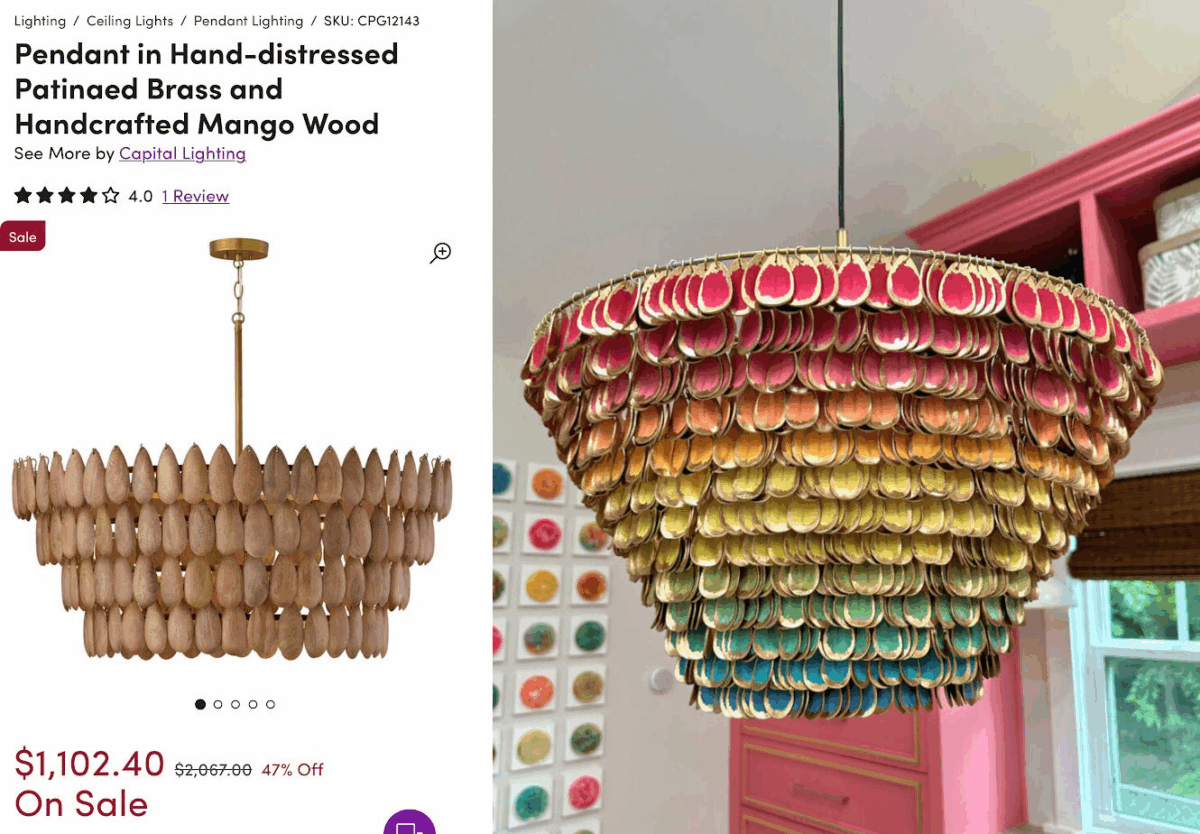
And in the description of that post, I started with “This is why I DIY…” and talked about the price difference, etc. Now, of course, I have an advantage in that DIYing is literally my full-time job. So for me, time isn’t an issue. I realize that for those who work a full-time job, spending hours and hours making something might not pay off, so you’d be better off saving up money to purchase the item you want. But I compared not only the price difference, but also that by DIYing, you end up with something that is completely customized to your home — size, colors, etc. — and very often wind up with something that is completely unique and one-of-a-kind. Plus, there’s the satisfaction of being able to look at that thing and say, “I made that with my own hands!” For people like me, that’s one of the most satisfying feelings in the world, but I realize it’s not important for a lot of other people.
Anyway, blah, blah, blah. That’s not even really the point I want to get to. That’s just the background of where today’s post came from. My question is about the responses that I got from a handful of people that genuinely shocked me and made me say, “Wait…WHAT? Seriously?”
There were only a few, but the comments went something like this…
These aren’t even remotely similar.
It’s not a version of that lamp. It’s a completely different lamp.
There are literally NO similarities.
Anyway, you get the point. The post has 630 comments, and these types of comments were a very small percentage. I would say I got no more than 10 comments from people who said there were NO similarities between the two lights. But these comments astound me, nonetheless.
I want to impress upon you that this has nothing to do with “mean comments” or anything like that. These comments weren’t mean. They didn’t make me angry. That’s not the point of this post. The whole point is that I’m truly and genuinely fascinated by the fact that some people can look at those two lights and see NO similarities at all. It’s like I want to study their brains. I want to spend a week shadowing them and see how they process information from the world around them and then compare notes at the end of the week to see how differently we both process the same information.
In fact, when I got the first comment about there being NO similarities at all, I just wrote it off as coming from someone who probably likes being a contrarian online. But then I got another. And another. And another. I thought, “How is that even possible?“
Because I look at those two lights and I see nothing but similarities. They both utilize multiple rings hung together on different levels in descending order of diameter. They both create visual interest with one item used hundreds of times in repetition. Yes, there are differences. The Wayfair light only has four rings, and mine has thirteen. The Wayfair light only has one color, and mine has thirteen. But the overall concept is the same. At least it is to my brain and the way that my brain processes information.
I’m so curious to know if you can see that or not. When you see those two lights side-by-side, does your brain tell you those are similar lights that are based on a similar design concept? Or does your brain tell you that there are absolutely NO similarities in those two lights?
Again, I ask for no other reason except for sheer curiosity. I know there’s no way to do a scientific poll on my blog, but I’m so curious about how the numbers are split. Will it be 50/50? Or 90/10? And if you see no similarities at all, how would you describe yourself? Would you describe yourself as a creative? Not creative? Do you enjoy doing creative things?
Maybe I’m not even asking the right questions. I just want to know more. I want to know more about the people who look at those and say, “Nope. Not similar at all.” I want to study your brains. 🤣 I want to understand how your brain processes information from the world around you.
Interestingly, the light that really inspired my studio light was the one that hangs in our music room.
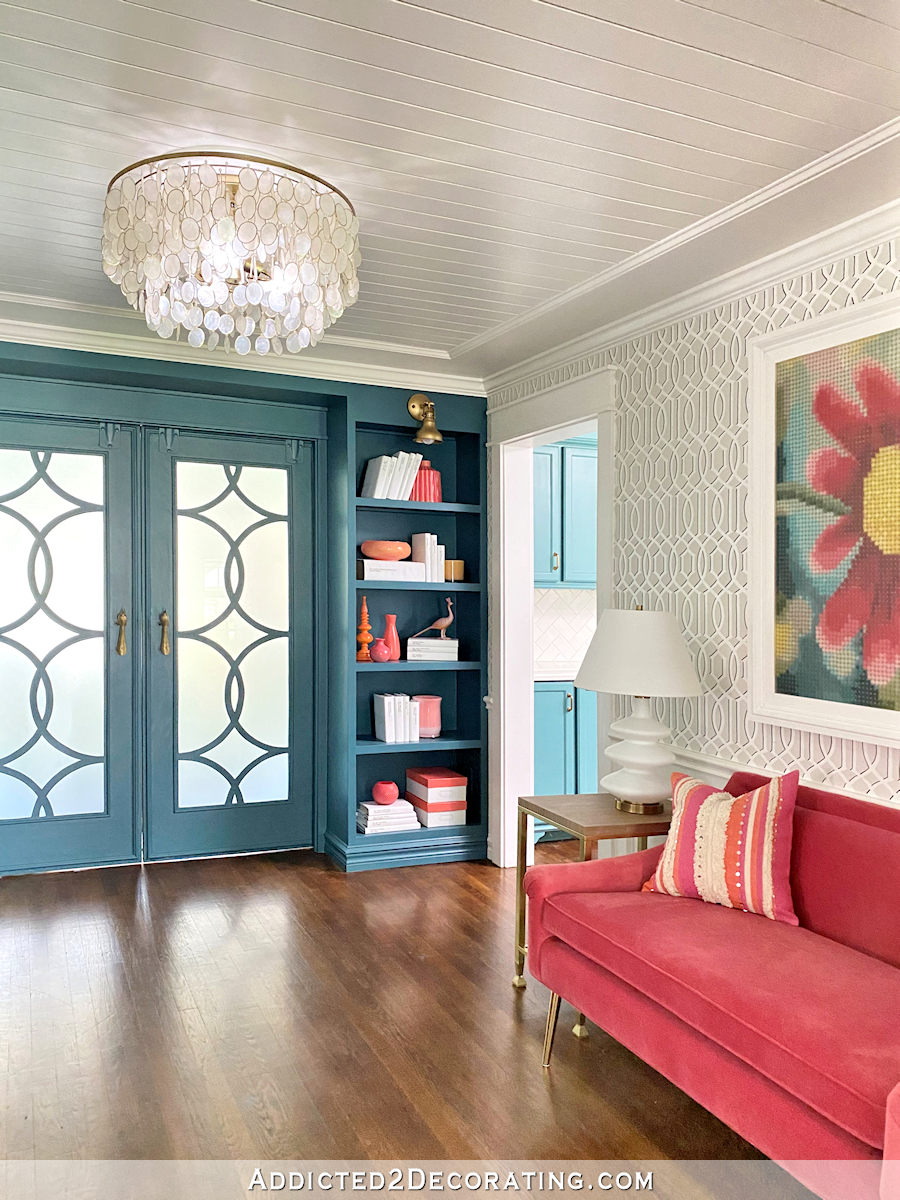
That was my main inspiration. Again, I look at those two lights and I see many similarities. Are they the same? Of course not. That music room light has all of the rings on the same level and utilizes strings to attach multiples of the same item (capiz shells, specifically) on one string to create the visual of different levels, with the shorter strings around the outer ring, and gradually getting longer as they go towards the center of the light.
But that’s the main light that inspired my design on the right. So how about these two? Do you see the similarities in these?
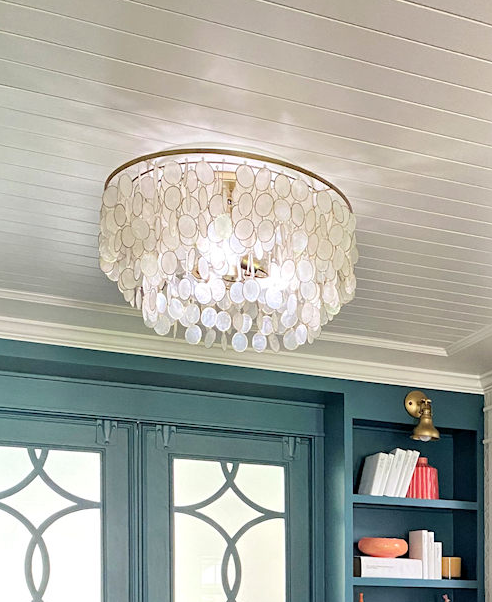

I’m guessing if you answered “No” to the first comparison of the Wayfair light and my studio light, then this is a “Heck no!”. But if you answered “Yes” to the first comparison, is this a “Yes” also? Or is this one a “No”?
Anyway, I hope you’ll indulge me as I delve back into my psychology past for one post. I’m genuinely fascinated with this, and I’ve been thinking about it for days now. I’m fascinated with how different people process information and process the world around them. I’ll get back to the closet tomorrow, as my plan is to spend today working on the island. 🙂

Addicted 2 Decorating is where I share my DIY and decorating journey as I remodel and decorate the 1948 fixer upper that my husband, Matt, and I bought in 2013. Matt has M.S. and is unable to do physical work, so I do the majority of the work on the house by myself. You can learn more about me here.


I see similarities in both lights, but more in the one in your music room. I do like to DIY, although not on your level!
double yes! Different but very similar
I agree with Barb!
Yes, they´re totally similar in so many ways. All of the three lamps.
Creative, does many kinds of DIY
Actually the only similarity is the shape, with the larger part at the top and smaller part at the bottom. They are dissimilar because one is many layers with a gradual decline; the other has distinct changes in size. One is much longer than the other and of course the colors are so different. So all in all to say they are similar is not a 50/50 to me.
And my taste would have put the larger circumference at the bottom, just my preference.
I find all 3 lights similar, but also that Wayfare one is so overpriced! The “regular” price is crazy.
I totally agree! If I’m going to pay that much for a light (which I never would), it would have to have at least three or four times the number of doodads on it than that Wayfair light has. 🤣
I also find all three lights similar. Although your music room light is more similar to my mind. I love to decorate, and some people say I have talent. Definitely do not have your eye for creativity. I can’t wait to get your posts in my email and sometimes keep refreshing my email looking for yours. Although I do not prefer as much color as you, I certainly can appreciate it. I sure get a lot of ideas!
I utterly love your studio light, it’s so beautiful. My answer to your question is, Yes. I can see similarities in the 2 lights. Even with the third one too.
I definitely would say the Wayfair and your studio light fixtures. The the light fixture in your music room is also similar. I consider myself creative. I thought about going to College for Creative Studies in Detroit then decided on majoring in clothing and textile design/retail mgt. at Michigan State University. I’ve been sewing clothing for over 60 years, including designs I created myself. I also sew draperies and bedding and do smaller upholstery projects. I enjoy cooking and baking. I enjoy reading all the suggestions people post here.
I see similarities in all 3 lights.
Ditto
Yes, I can see a common thread between the three, but there is only one that I like.
Similarities in all three of the lights, although I thought the store-bought version in the last post was too ugly to be compared to either of your lights. Please paint your island Navy — it really makes the wallpaper pop. All the other colors compete with it. Maybe consider a change in the door color?
Yes, I see similarities between all three. The Wayfair example is more structured than the other two and your studio light shares the overall feel of the music room light but the basic concept is there in all three.
And I totally get the satisfaction of creating something with your own hands.
Ditto
Yes, I see the similarities.
Do you see two table lamps and think they are similar or do you see two table lamps that are dissimilar?
Construction is one aspect of an object design choices are another aspect that can transform our final perception.
I know you’re trying to sound deep here, and I don’t wanna ruin that for you……but it’s kind of impossible to answer your question without actually having two table lamps to look at and see if they actually look similar or not. Like, this isn’t hypothetical – I can imagine two table lamps that are legitimately very similar-looking, or two that are totes different. We kinda need real examples to sus out design similarities/differences.
She is comparing 2 or 3 ceiling lights, not table lamps. The pictures of the lights are in the beginning of the blog. Or I am very confused.
I went to a design school for fashion and a lot of the curriculum required us to break down inspiration and objects to its most basic design elements and recreate them in similar but different ways. Design interpretation is innate but also can be taught or developed. I think your light fixture is very much inspired by the 2 others, there are many similarities – shape, repetition, descending diameter, hanging items, feeling. By pushing the design using editing, testing, and crafting it to the unique circumstances of your intended space, its more of a piece of art with a function. I think there are people who struggle with visualizing things in different colors or spatially and others that this comes very naturally to. My brain can change objects like working in photoshop, where as my best friend has to “see it in the space” and doesn’t trust herself otherwise.
My brain can, too! (Spatial and design) But I also like seeing it in IRL, which only confirms my vision. I am pretty good with design myself. Like the Wayfair lamp would be improved with 5 rings. But egads, that price!?
I see both similarities and differences. I don’t consider myself to be very creative. I can sometimes visualize ideas, but don’t have the skills to carry they out to my satisfaction. My diy was always pretty basic and for practical reasons only. I can really appreciate the vision and go for it abilities. You exemplify, though. I was a social worker in my professional life. Retired now.
So, bit of background here: I’m a fellow DIYer also renovating my own house. I’ve built my own furniture (not very well – it’s always a little wonky), and I like making art, too.
The wayfair light is SUPER similar to yours! The only real differences are the number of tiers, and the wood tone vs. all the colors. In fact, I think the Wayfair light is more similar to your rainbow light than your original capiz light!
Anywho, point is, I literally don’t know how anyone could see those two lights and say they’re not alike at all. That’s bonkers!
Forgot to mention, I work as a data analyst (though my job is more focused on finding and pulling specific info out of masses of records than doing statistical analysis), so I’d characterize myself as both artistic and analytical. Furthermore, I’m always trying to DIY materials into purposes they weren’t originally intended for – for example, I built a coffee table out of a small shed window. These projects of mine tend to baffle the hubby, but he usually likes the end result. He’s an engineer, but he professes no desire to create art or craft stuff. It’s interesting, but I tend to rely on mental visualization to solve problems whereas he’s really bad at visualization (per his own opinion). He’s much better at math, though. Maybe mental visualization ability affects who can see the similarities in the pendant lights?
I totally agree. If someone wanted to get to the science of comparison, I think the Similar column would be alot longer than the Dissimilar. Some people absolutely cannot imagine what something will look like without an exact picture. Personally, I think that the Wayfair light looks cheap next to Kristi’s. It doesn’t look opulent. The wood looks flat & unfinished even if it is a fancy wood. Like something a kid might try to make for his/her Mom. I think “opulent” is one of those adjectives that either describe something or it doesn’t. Easy to tell the difference. Overall, the idea is similar even if the “expensive” execution leaves something to be desired.
Some people simply can’t picture what things would look like when described without a picture. For all us DIYers, the other thing I realized in my creative pursuits, is that some people can look at something and don’t see the possibilities of parts & pieces rather than what the item was manufactured to be originally. I was married to one of those people! Lol When I was a teen, my Mom bought 2 vintage countertop water pumps that you had to pump by hand. She saw 2 very nice table lamps for her LR. My Dad welded the handle so it couldn’t be moved, made a wooden base and wired them. They have burlap looking shades. I still have them.
I am DEFINITELY in Team Similar!
On the original post, I recall thinking, I guess I can see some overlap, but I don’t consider them super similar. If I tried to put a totally non-scientific number on it, maybe 25% similar. For the music room light, I’d go with more like 70% similar. While, unlike the first one, the materials are totally different, the concept seems much more similar. I guess maybe this means that to me a thing is more about its structure than its finishes. (And your DIY is by far my favorite of the three!)
This is one of those easier to discuss than type nuances (sp?). Pretty much you are writing a gut thought, then detailing that as it develops. Audience reads all of that then develops more detail, generally different. The more different because their background creates the more varied responses.
I think variance of answers is the context and rest that comes with it. The Capiz/DIY shade comparison are similar texture but not color, nor light it has.
The wood/DIY has a gut similar outline/shape. When defining what, you see dissimilar – texture, color scale if pieces, you find differences. Things most similar is they have areas that do not diffuse the light, but block it.
The details each observer sees relates to their past experiences. Items that are easier to clean, maintain and less shadows generally get my vote. The more finicky the more I dislike. I hate lights that are tough to clean/replace bulbs and block vs diffuse light. I’ve witnessed too many unfinished maintenance because it was tough to re-thread parts back together, wrong/mismatched bulb, or collect cobwebs. Grew up with dated lamps we shouldn’t touch but yellow and covered in dust. Fixtures with a ton of bulbs are avoided because I see each as a way to fail and don’t want the risk.
Absolutely I see similarities of the foyer and studio and the Wayfair is somewhat similar. It’s pieces do not seem to dangle as much but the concept is similar.
Well, I tried to comment yesterday and the dang thing wouldn’t post. Trying again today. Yes, I see similarities is shape and design, absolutely. I also see similarities in the two lights you have in your home.
I once heard or read that the ability to see categories is an indicator of intelligence. So, I might go so far as to suggest that the people who didn’t notice how those two lights are similar just weren’t too smart. Maybe they didn’t watch enough Sesame Street. I’m not kidding. Remember “One of these things is not like the others?” I had to go to Wikipedia, which says, “Children who watched the show regularly improved significantly in their ability to sort objects into like and unlike categories, and this improvement has been attributed in part to this song.”
Have fun with your findings. For the record, I’m more artistic than analyttical.
I didn’t read your comment until after I replied. Sesame Street quote also! And I probably lean more analytical than creative.
Hey, Kristi,
My thought is that all of the chandeliers are in the same theme—spherical with rows of small pieces that make up the sphere. But my brain is Big Picture, and an analytical brain might be more attune to the details rather than the overall effect. Aren’t people interesting?????
Definite similarity between the lights 🙂
I see many similarities in the Wayfair light and the one you made in the studio. I see some similarities in the music room light but they are not immediately apparent like the other. The shape and construction of the studio pendant and the Wayfair light are like “sisters” whereas the music room and the studio are like “cousins”. That is how I see them.🤷♀️
This explanation is better than I can write it! Agreed.
Also remember in a writing class in law school that we were to analyze whether duress caused a person to change their last will & testament. 70% of our class concluded duress had occurred, 30% concluded no duress. I was so puzzled as to how anyone couldn’t see that duress had been put on the deceased person to change their will! We discussed it ad nauseum and I remain fascinated that they could come to such a conclusion.
I also remember reading many years ago about the effects on children of different activities. They tested the kids, scored the tests, then the children were given a task. I think the tasks were an art project, music, a reading assignment, a game (like pacman), and something else I can’t remember. The children were tested again and their scores were higher when they did art and music. Reading left their scores equa, and the game and the other thing lowered their scores.
Of course when school funding gets cut, art and music are the first to go here in my state, sadly.
Kristi, the human mind is weird and wonderful. Thanks for sharing.
And yes all three are more alike than not.
Totally similar for both!
On first glance comparing studio light my thought was no, but after enlarging pic it changed to yes. As to the shell light my first answer on that light was a yes. I don’t thing my brain is analytical but more to the artistic side. Interesting question. Looking forward to the answers
Interesting question 🙂 I have a math/computer science degree and consider myself more analytical than creative. I am a crafter, not an artist: by that I mean that I don’t come up with anything new, I copy what someone else has done with mostly minimal changes. I currently work as an IT professional but spent several years teaching high school and college math. I read lots of articles about learning during my teaching years, especially on how to teach (or how we learn) problem solving. One of the biggest steps in problem solving is recognizing similarities between disparate things. This makes sense to me since if you can see that a new thing is like one you already know how to solve, then you have a starting point for solving. Bottom line: I do see similarities in the lamps and can see how you made the leap to create yours (though I would not have thought of your idea 🙂 ). I think your brain is analytical enough to have taken the inspiration piece and figured out how to make your version: a fusion of analytical and creative. Before replying, I did an internet search on ‘ability to identify similarities predictor’ and went down a rabbit hole (yeah, I’m a nerd, lol) of how ‘similarity judgment’ is used in many algorithms and AI. Sorry for such a long essay, and thank you for an interesting question ! I look forward to seeing what other people respond with.
Absolutely. A clear path from inspiration to creation. An easy comp with wayfair.
For me it’s too different to describe as similar because of the amount of individual hanging spoons & the amount of colours – it’s only similarities are that it’s a pendant lamp with more rings/layers. For it to be similar it’d need to be at least similar – one single colour or couple of colours similar to the original. The original is a “simple” design but yours is way too busy to be described as that. Yours is very busy in every way & the original just isn’t. Thats my view & not to belittle your design which is lovely in it’s own way.
Yes, I see similarities. Especially between the overpriced Wayfair light and yours!!! I DIY all the time, like you! I’m an idea person.
Yes and yes. I think the one in your music room is much closer but they both have similarities.
Yes, I see similarities between all 3 lights. I am a creative person who loves a good DIY project.
Yes, similarities! 🙂 I’m a DIYer too so maybe that is part of the equation?
I see similarities in all three lights. I am very creative and if I saw a light like Wayfair or the Capiz shell light, my mind would take me to visions of what I wanted to see and extrapolate the qualities in both lights that I wanted to use in my own light. I think that is what creative people do – see something and then think, “Hmmmm, I wonder if I did this instead…”
I also believe that everyone has some creativeness in them , but are subconsciously too insecure, maybe, to manifest it, because the results may not be as good as yours, or somebody else’s.
Both the Wayfair and your inspo capiz shell light are similar to the studio light. They follow a similar concept for a similar appearance. Are they twins? No.
I am very much an analyst type of person, working in IT. Patterns are what I “see” in the world which assists me with troubleshooting and identifying anomalies in a sea of similarities.
I do enjoy creative projects and activities. These days it’s mostly landscape design, gardens, painting my yard in flowers, shrubs and trees. 🙂
For the record, I submitted this comment prior to reading the others.
There are definitely similarities in the lights …I can see the style of the expensive one inspired you to make yours, which you took way beyond and is gorgeous.
I am a very creative person working in a very analytical profession, so I think I may be able to help with this exercise. My creative brain can see the similarities and understand that the original fixtures could inspire the design of your studio light; my analytical brain can give you 5 times the amount of differences between the 3 lights.
The shape, the texture, the movement, mounting style…those things are all mirrored across from the inspos to the studio light. When you are a DIY-er or creative-type, it is incredibly important to be able to find inspiration without directly copying another person’s work, which means that small details and emotion are pulled into the front focus. With all the small details in the front focus, you can find similarities where others may not. When you are looking at a product as an end-user, it’s much easier to step back and take the whole item at face value. When you’re that far away, a colorful movement-filled light looks absolutely nothing like a rigid wooden light.
Hmmm.. I’d say that even though they are similar in that they have similar composing elements, they are totally different. While your chandelier is full of energy, flamboyant, the mango one is subdued, minimalist, veering towards primitivism.
So, yes, they have nothing in common in the way they present themselves, even though they have a similar anatomy.
Yeah, same, but different!
I’m creative and analytical.
I definitely see the similarities. But I wouldn’t buy the one from the store. Yours is more me.
I see similarities in both pairs of lights — they echo themes. I’m creative with lots of arts & crafts experience and do civil engineering as a job – which is more creative than you might guess.
Yes, I see the similarities in all of the lamps. I too am a creative and a DIYer. I get a great sense of achievement by creating things that I could never afford to purchase. They may take a lot of time and effort, but I have more time than money, so I justify it that way.
I think if you replaced all of the “danglies” on the light you made with the unpainted wooden spoon bowls and turned them convex-side-out, they’d see it better. I can certainly see the inspiration in the Wayfair light. I see it more in the music room light because there are more layers and the “danglies” are much danglier (more dangly?). I definitely agree that if you make something as impressive as that light fixture, it’s going to get so much more positive attention and admiration than just a store-bought one. Plus it gets you into smaller scale crafts rather than large, longer-term projects (well, I say longer term. I know that lamp took you quite a while to finish. But it was probably more fun to work on that sanding and painting cabinet doors).
I see more similarities between the capiz and the office light than the office and the wayfair, but I see where you were going with the tiers. I am a scientist but also a very visual thinker. I found out this year that there are people who have no internal imaging, so if they read they don’t “see” the world they are reading about. Or if you ask them to think of an apple they don’t see the picture of it in their mind. That just blows me away because I am so far in the opposite direction.
I see the similarities in the two lights and can appreciate your inspiration. In fact, it’s one of the funnest things about your blog – I get to see how you are inspired by an item/idea/concept and then you make it your own by DIY.
I can definitely see similarities in all of the lamps! For me, it’s easy to see the initial inspiration and the creativity that went into the colorful fixture. For the psychological stuff, I’m a bit of a conundrum: I’m very creative AND analytical. I have a degree in Interior Design and a degree in Business Management, but I disliked working in the design field. The most creative positions tended to be the lowest-paying, and I didn’t enjoy being creative under pressure. For me, I must have an analytical job (love spreadsheets!) during the day and creative hobbies the rest of the time. Weird, huh?
I agree with you Kristy, all three lights are similar and it seems strange that anyone else couldn’t see that. Where we differ is I am more analytical (even skeptical, sometimes cynical – it’s my job). No studying my brain!
All three lights are thematically similar to me, though if I were to put the shell one next to the wood one, the similarities between those two alone are a lot less (much closer to zero) than between your hand-made light and either of the other two.
FWIW that wood light is boring to my eye and hugely overpriced to me because of it. Different strokes, this is why everyone does not live in identical surroundings!
I see the similarities in all 3 lights for different reasons. But I also think the music room light and your office light resemble each other more.
I am a DIYer….not to your skill level, but I tackle most DIY projects myself and totally enjoy the satisfaction I get from knowing I did it myself.
Yes I can see the similarities in both, the second one in particular 🙂
I see the similarities with both lights.
Your work inspires some of mine and if someone asked me how I got the idea for something or other I’d done, your blog would be something I’d point them at (as well as other sources). But in the end they are my creations, not copies of yours, and so it should be!
And if you have a sudden rush of blood to the head and decide you want to fill your house with crocheted clutter, feel free to get inspired by me 🤣🤣🤣.
As soon as you said you want to compare the lamps to determine similarity my brain went to the kingdom class maps of how these function. Curious to see what others think. For the one in your studio, here is my breakdown and I personally love the music room lamp the most.
Kingdom – Lighting
Phylom – Residential
Class – Decorative
Order – Pendant
Family – Tiered
Genus – Colored
Species – DIY Tiered Rainbow Pendant Light
Wow, Jennifer! I wish my brain were as scientific as yours! You nailed the kingdom class map, and I couldn’t even name the different components of a kingdom class map.
I find the music room much more similar to your desk light than the Wayfair one. I think it’s due to the structural rigidity of the wooden Wayfair light. It may technically dangle, but it doesn’t look like it would have any movement to my brain. However, I still see similarities. I wondered if someone writing of no similarities is approaching it from a “trademark lens”. What I mean is that the lights are different enough that I would never accuse one or the other of copying an item, but they certainly similar to me. Perhaps that’s the angle they were considering when not seeing similarities.
I am also interested in processes. The way someone solves a mathematical equation in their head (like making change for someone paying in cash) is always interesting to me, because there are multiple ways to arrive at the answer. I used to think math teachers had you show your work in order to award partial credit for a partially correct answer, but now I wonder if they were just interested in how their students thought.
I would consider myself more of a crafter or a frustrated creative. I am not artistic, but I can look at multiple things, pulling singular elements I like from each, and create something that may appear creative. In reality, I copied lots of little things and someone liked my compilation. Cake decorating was a good outlet for me for a while. You can pull inspiration from lots of random places – but the execution is very exact (like figures in a coloring book). This is comforting to someone who struggles to draw stick figures. I’ve convinced myself that woodworking is my new hobby, partially because you do such a great job describing the process. So I have some lofty ideas for built-in cabinets in my office!
The bio nerd in me loves that you classified this via the kingdom of living things!
Probably why I compared the lamps to plants in the carrot family—similar components but different “species” of lamps.
Yes, they are definitely similar. Yours is far prettier, but clearly have similar lines.
Definitely, I can see general and overall similarities, although each one is literally has different shape and color. I would define that by saying I see it as overall CONCEPT, NOT DETAIL. I am also a DIYer, although not to the extent that you are. I’ll throw another wrench into this mix: If you consider the age of commenters, my guess would be that the older the person is, the more likely it will be that they will see the similarities and the younger, the more likely they will not see them. For context, I’ll be 78 in August. My experience has been that the the older we are, and the more wars and life challenges we’ve seen and experienced, the more they have shaped the way we see things in broader scope. In many ways those experiences have helped us to see more creatively, because we had to if we wanted nice, pretty things. We simply could not afford to buy them. We had to be creative and work to make our own things. Perhaps those experiences have also helped us to be more “individual” and choose to make/create the things that we truly love rather than just accepting the “cookie cutter” options that manufacturing and social trends brought to the forefront of modern society. I may not have said this very well, Kristi, but I think you will understand what I’m trying to express.
The Wayfair light and your studio light are similar – multiple pieces of small wood arrayed in tiers. Your studio light and your music room light are similar – small dangling circular shapes. Taking it further, the Wayfair light and your music room light are not similar – totally different materials and styles, tiers vs. dangles. I think the difference is in how people view similarity. If I were to make a venn diagram of the three lights, I could write a lot of shared characteristics between the Wayfair and studio light and the studio light and music room light. To me, that makes them similar. Others I guess are looking for a closer match with color and shape and form.
I would consider myself very analytical. I can be creative, but require a good amount of inspiration and then I analyze it to death. I am an extreme perfectionist.
Yes, I can see the similarities and the inspo while they are not identical.
I see the similarities with the Wayfare light. But not with the other light other than they both are round.
Yes, I see the similarities between all three, though to me your DIY light is more similar to the Wayfair light than it is to your music room light, mostly because they share the same silhouette.
I’m a civil engineer. “Brain” tests indicate that I am both left brained (no surprise there) and also very visual. I do create things (I sew, knit, do stained glass, etc),but I’d call myself technically competent more than creative. I can figure out how to make something I see much easier (theme and variation) than I can come up with an original creation. E.g., when we gutted and completely redid the interior of our 1937 bungalow home, I copied your interior window frame design (thank you for the tutorial). My husband is also a civil engineer. I’ve noted that I have an easier time “visualizing” in my mind the potential outcome of a project than he does. We are both DIYers, but that’s not uncommon for civil engineers, I’ve found. We are trained to implement the most economically efficient solution to a problem. Personally,I also prefer to “reuse, repurpose” in order to minimize my impact on the earth’s natural resources.
Definitely similarities but yours are so much better! I would always choose handmade & unique over mass produced!
Yes I see similarities in all three. Also, this post for me brought up the issue of looking at the world by glass half full people vs. glass half empty people. In my opinion you are a glass half full thinker as am I. I hope that doesn’t seem snarky to anyone!!
Yes, I can certainly see the similarities! I think I’m just on the other side of the analytical vs creativity spectrum from you, Kristi. I was in medical research for 27 years before turning to my gardening work and did enjoy it, but during that time, I also created small projects in sewing and fiber arts. I used my analytical skills to figure out just what that creative inkling was in my brain and then what I needed to do to get to the end result. I would not say I am particularly creative at all, but analytical, yes. So it all worked. I love seeing your wonderful projects, and how you approach and explain them is terrific!
I definitely see similarity between all three lights!! I am a creative person, too, and I much prefer your beautiful, individual, and colorful version 😁
I see all three lights as similar. I always view cooking recipes, crafts and sewing patterns as a jumping off place, an inspiration.
Oh, for goodness. Of course both lights have similarities to the one you created. I’m not sure if those who can’t see it have a different psychological make up or if they process the word “similar” in a different way. They need to go back to Sesame Street and “one of these things is not like the other” would have all three lights you’ve shown and there’d be a bare lightbulb for the 4th one. THAT one is not like the others.
All 3 are similar.
Yes, I do see a comparison in all three lights. It’s the graduating rows, or strings, that make them similar, plus the shapes of hanging pieces.
I DO see similarities in the inspiration lights and your diy light.
I see the similarities. The shape of all of them with a twist to the material. It’s an impression of the design that you ran with. I get it. Oftentimes I will see an item that gives me a starting point for a DIY project but the end result will be different from the original. That’s what being creative is all about. I think the “fashionable” term these days is bespoke. Essentially a one-off item or custom made.
I immediately saw the similarities between the Wayfair light and yours. My second thought was, I wonder if I could copy the Wayfair light using those compostable bamboo serving spoons and maybe paint the whole thing blue or another color? Then, I wonder if Kristie could use bamboo serving spoons as petals for her closet pendant light, or maybe I could do that for my own light project?
I’d call your studio desk pendant a mixture of the the Wayfair and the capiz shell pendants. It has elements of both.
That was the first thing I thought of when I saw that Wayfair light, too.
I think there is similarities in all three. But the Wayfair one is just plain ugly with the
monotone color. Plus it certainly looks like most of the light when turned on would be very minimal unlike yours. Why would anyone pay over a thousand dollars for an ugly and basically a useless light. Yours are quite beautiful and are very practical for lighting a room.
I wouldn’t directly say the two are alike, but I would say that the one is “inspired” by the other. The wayfair one has smililarities, but it is far more structured than yours, which makes me not see them as the same. I have an engineering mind, but have had to get better at working with/translating with my interior design co-workers and have seen how they view the word is vastly different from how I do. I’d say the one in your music room is far more like the craft room light, both multiple layers, dangle/loose structure, meant to move in a breeze, but neither are really like the wayfair one.
I think the first two are similar. Of course, there are many differences but I can see where the inspiration came from. On your music room light and studio light, I can see a couple of similarities but they are not quite as close as the first two.
i consider myself somewhat creative. I love putting things together myself and I’m happiest if I do have projects that I’m working on. I’m also very practical and don’t feel like my creative endeavors are very good.
This makes me think of how witnesses to something can have very different descriptions of the same things. I don’t understand how people can perceive things so differently when looking at the same thing.
It will be interesting to see what the percentages are in your survey. Please come back with a follow up and let us know.
Yes, to both lights. And if anyone possesses even the “slightest” amount of imagination, they can easily see how you make the leap with either light. I too find the brain a fascinating subject. We just do not know what it is capable of, within regards to healing ourselves, or longevity or our overall health. What we have witnessed as humans throughout history is just the opposite of what we are capable with our minds, not least our actions. But that is a discussion for another time. I have a very analytical mind myself and being married to a man who is a Nuclear Engineer and a PhD, trust me when I say we have some heated arguments about how to achieve the very same result. I have learned to color outside the lines, and he has learned that there can be another way of doing something, not just his way. I sometimes have to remind the Colonel that he is no longer Large & In Charge. A farm will do that for you. I used to strive for perfection, now I strive for good enough. It’s OK, there is an enormous joy in a completed project, whether perfect or not. I love your stamina, and I wish at age 59 that I had at least half of it. You are truly an inspiration, I love that you plan it out, get it going, and finish it. If you don’t like the results, you change them, and that is an amazing brain at work. Thank you for letting me/us, be a part of that journey.
Cheers to you and Matt and The Furry Crew!
I can see similarities between the two–but would not consider yours a DIY of the other light. There are similarities but they are not the same. A dog is similar to a cat in a lot a ways–both have fangs, fur, and claws–but in no way would someone look at a dog vs a cat and think they’re even close to interchangeable. That’s how I feel about the two lights. Sure, there are some similarities…but in no way are they interchangeable. The whole look is completely different.
Like you, I am creative and love to make things for my home. Your lights are similar to the Wayfair light.
I definitely see the similarities but I’m not sure, if I had seen the Wayfair light on the website I would have said to myself “that light reminds me of the one Kristi made”. But I am a creative, not sure whether it’s out of necessity or it’s how my brain works, but what I do know is that if I see something I like (love?) my first thought is “how can I make that and save money”? Then it’s down the Pinterest rabbit hole I go.
Sandy, Why should you be different? I think all of us on here have creative minds to one extent or another. I do EXACTLY what you’re talking about! Mine started in a childhood of poverty in the 50s. Life followed one rule: Use it up, wear it out, make it do or do without.
My first thought throws me down Pinterest too but it’s the second thought that gets me in trouble! The one that says Do it FASTER, EASIER & CHEAPER! I can’t tell you how many fabric patterns I’ve altered to do all three! Making children’s clothes for my girls: Zipper, I don’t need no stinkin’ zipper! Cut the neckline a little lower in the back, Don’t sew the front seam all the way up or make a V neck, put the back bodice on the fold and save fabric, forget facings, used bias tape I made myself (kids grow so fast, not likely to be a wear or support problem). Been doing it this way for almost 70 years now.
Have gone from childhood poverty to owning almost 40 sewing machines incl antiques, one-trick ponies, sergers, coverstitch and regular all the way to the Brother Luminaire. My last modern sewing machine!
I see similarities in all three. More so in yours and Wayfair, but it’s still the same concept to me. I’m not analytical at all, (I don’t think) but I can’t create something of my own without seeing something similar before hand. So, not a good judge of all this. 😂🤣
Of course they’re similar. Not ALIKE, but similar. You have very specific styles you gravitate toward, adding your own personal details to make them your own. Inspiration is just that. You are inspired by someone else’s design, but only use it as a jumping off point for your own interpretation.
I see similarities.
I think the disconnect comes from how the post was framed. In particular:
“This is why I DIY. Not only do I get exactly what I want […]”
and
“You don’t have to wish for things that are beyond your budget. You just have to use a little creativity, and you can almost always come up with a way to make it yourself at a huge savings.”
Starting the opening and closing paragraphs with these two sentences sets up an expectation in the reader’s mind that the DIY version started as a version of the Wayfair product. Nevermind that your second sentence says you saw the Wayfair image long after creating your own light – we all know people skim and because of the first sentence they already have a bias toward believing that this is a “dupe” post. The comments then saying, “these aren’t similar,” are a reaction to that bias and thinking your version didn’t match their expectation of what a DIY dupe should look like. You can press them to look for similarities, but they’re not going to contradict their initial opinion because it would force them to admit they’re reacting to the wrong thing.
Anyway – in my opinion, there are some similarities, but not so many that I would have thought to compare the two lights as a “buy vs DIY” post. Turned out great for engagement though, so well done!
I think this is so true! I had the same thought… the folks who posted were commenting on whether the DIY light was an effort to replicate the Wayfair light, rather than on whether the two lights are similar in the abstract. 🙂
Yes I consider all 3 lights similar–each unique in their own ways with differences and not replicas but yes very similar. I’m a creative who has crafted for years and learning home DIY (not even close to your level though). I also love psychology and what makes people think and behave the way they do, effects of their backgrounds and experiences on their behavior, as well as effects of their religious beliefs (or lack of) on attitudes and behavior. All of that to say this is interesting and fun! ☺️
I didn’t have any problem seeing the similarity in the first two, but don’t see similarity in the second two. I have a mostly analytical mind with some creative areas.
I see similarities in both comparisons! I find the Wayfair light to be boring and not to my taste. Your studio light is a little busy for me and way more work than I would have attempted. I really like the music room light the best! Although, I don’t think you were asking which one we liked the best! lol I am a creative person, in my opinion. I prefer to have an outline, directions/instructions, or some kind of guide. Then I change up some elements to suit my style or situation. Even though your work method and personal taste is different, I still learn so much from you and you spark ideas for my own projects!
I see similarities in all three. I am a visual artist and have always been creative in various methods and media. Maybe it’s an abstract link only seen by creative minds.
Similar! But I’m like you, I like to look at something and figure out a way to make it better/mine/cheaper. Maybe that’s the DIY’er brain vs the buy it or have someone else do it brain?!
Yes. All 3 are definitely similar.
I absolutely see the similarities. I just wish I had your DIY skills and the time to do them. Love all you do.
I responded to one of the comments that stated your DIY looked nothing like the inspiration light. I was very surprised they didn’t understand that it “inspired” your version. I didn’t take their comment to be mean-spirited; like you, I just didn’t understand how they didn’t grasp the inspiration aspect.
Yes, I see the similarities and I like the one you made better!
I will admit when I first saw the Wayfair light and your light side by side, my first thought was “those aren’t alike”, then I looked at them and said “yes they are”. The color threw me off, the one you built is so colorful that the Wayfair light looks kind of boring. I immediately recognized the similarity between the music room light and the workroom lamp. FYI … I tool am a psychology major and decided my introverted brain would not make a good therapist. I ended up in IT but enjoy DYI and am the handywoman/ gardener around our house and my children’s houses. At 65 I painted my daughter’s house while she was on her honeymoon. My favorite garden tool is a chainsaw 🙂 Hope this helps.
Here is my response. By the way, I am creative and paint most days. I restore primarily jewelry boxes inside and out. About your light fixture in your studio. I see you were inspired by the light fixture hanging in your music room. It looks very similar to the light fixture you created for your studio. I see a slight similarity in the Wayfair light fixture and can see how it reminded you of your studio light fixture. But the music room fixture is more similar than the Wayfair fixture. There are people who see in black and white meaning very little visualization in their mind and those who see in color and can develop a concept in their mind as to what they wish to achieve. This concept grows and expands as work progresses on the concept. You and I have that capability. I shop in thrift stores a lot to build my inventory and I used to paint furniture for resale and other unique smalls other than jewelry boxes. I’ve painted for 12 years. I can see the potential easily in an old beat up cast off when others see the beat up cast off. Hope that contributes to your experiment.
I see the similarity in all 3 lamps. I am a little bit creative, wish it was more.
I see the similarities.
Both of yours are far superior to the shop bought one, in my opinion. And the cost of selling one piece of your artwork (not just a DIY) would make it unaffordable to most.
I’ve the uniqueness of a DIY project. I’d also class myself as creative and artistic, just need to make more time for it !
So, there’s definite similarities between all three… Significant differences, but definite similarities. It’s like you took the Wayfair light + music room light, supercharged it with complexity and color = Kristi special 😁
I don’t think the Wayfair light would have really inspired your art room light though … There’s basic similarities, but it’s about like saying a home baker’s 2 layer basic chocolate birthday cake inspired a cake decorator’s 4-layer elaborate wedding cake complete with lifelike flowers and multiple flavors. Yes, they’re both cakes. Yes, they both have more than one layer. But beyond that? They’re not even in the same ballpark.
There are definitely similarities between all three as they all consist of multiple layers of discs. Your coloured doc light has always been more exciting with the colour graduation and flashes of gold, but I lack the patience to create anything like this.
I’d consider myself creative, but you next level!
I do see the similarities, but can also understand how someone might not. So many colors vs. complete lack of color. Painted vs. wood. I found a similar type of question while doing a jigsaw puzzle with my family. Some looked only at the color of the piece they were looking for while others looked solely at the shape (meaning piece with 2 “arms” or 4 indents, etc.). Yet others looked at both criteria, and so on. Interesting topic!
Yes, yes, and yes! I see a distinct theme in all 3. I’m starting on the studio light as we speak…if I can find your blog about the capiz shells light, I’ve got the perfect place for it as well. Already in the queue!
I believe they are similar for sure!! (All 3!) I am very visual, and highly creative.
Kristi, I’ve pondered this same type of conundrum over the years. Perhaps asking binary questions (similar or not similar) and giving binary answers (yes or no) steers us away from what we really want to know: how many attributes more similar than dissimilar? Or, it’s like saying, to what degree do two organism share their genes, instead of, are two organisms similar or dissimilar?
That you are inquiring suggests to me that you do indeed have an analytical mind, along with other attributes.
I totally “see” “feel” the sameness in all the hangy mabob lamps! Does not matter how many rings, levels, colors- it’s the vibe. And you nailed it!
I am a very visual person and also extremely curious about how things are made. My brain sees something like your lights and the comparison light and immediately processes how the components are assembled, the colors and shapes and materials used. I find the lights to all be examples of one basic design.
Very similar in form and function!
I definitely see similarities in all 3 lights. I consider myself artistic.
I immediately saw the similarity between the Wayfair lamp and the studio lamp. When you mentioned your inspiration was the music room lamp, I could see it too, but I wouldn’t have immediately thought of your studio lamp from seeing it out of context. I think the rings going down in diameter are more striking to me than the shell-like component. That being said, the vibe of all three lamps is completely different, so if someone sees color and mood and the type of room that the lamp would go in, maybe these lamps are not similar at all. In construction, they share strong similarities. So maybe to the DIY eye, they are similar, because you are deconstructing and reconstructing it in your mind, or seeing its “bones”, but someone seeing it as a whole and itself alone doesn’t go that deep? I don’t know. I definitely am a DIY type, except I design DIY things and draw them… then get my contractor dad to help me bring it to reality 😝
Wayfair light – VEERRRRY similar
White light – kinda similar 🙂
I don’t see how people say there’s no similarities in the Wayfair light. There’s more similarities than differences!!
So interesting, I’d say there’s more differences than similarities! For me, the width might be similar and they’re both tiered. But otherwise, the size (or at least height, the ratio of width/height is very different), number of layers, the colors, the style, the materials, etc all different! I wonder if some brains are more likely to focus on similarities/difference than others.
My initial thought was that light isn’t the same. But the more I studied it I started to notice the similarities. I am pretty literal about things to the point I might correct someone on a small detail that doesn’t matter. But I also love DIY and interior design, but I have to work very hard at being creative. Also when I find something I like and want to diy or copy it, I can’t just be “inspired by” I try to make it identical. Same goes for clothing when there is something I like and try to find at a store…hope that gives you some answers you are looking for.
Yep, there are definitely similarities between both pairs of lights! Do people maybe not know what the word “similarities” means? Do they think that “similar” means “exactly like” or “very close to”?
I see the similarities, I get how your brain works! Ha Ha ! I can’t even buy Retail, with out having to DIY it to something that is my own. You have inspired me to get back to decorating again.
I love every room you have done. I love the colors. I loved a reply comment you made to someone, who commented Teal is outdated!! I have been out of date then for 50 yrs too! Teal is also my favorite color. I’m inspired with the other colors you pair with it to make it look fresh and updated.
All three lights have similarities.
I definitely see similarities between the 3. The Wayfair and your studio light scream similar to me. (Although the Wayfair one seems dull and unfinished next to yours.) I consider myself creative – I love creating new things – but I’m also logical and a problem solver.
The first thing I saw when looking at the lights was the shape of them which was the same. Then I looked closer and saw the many small pieces hung in circles. Finally I saw the circles. The colors were irrelevant as that is personal preference and would be selected by the owner/designer.
As a life long artist l can tell you that l see similarities in the lights you made. Yours are more creative but l can see your inspiration plainly.
So that is your answer from me. BTW l still am in love with your pixel art in the music room. As an artist l can tell you l have met people who don’t understand my inspiration for lots of my art. Some people just don’t have that creative section of their brain. I don’t get how they do math, but l’m glad l don’t have to do it. This world needs all types of brains.
I also find all 3 lights similar but find the Wayfair light to look like a cheaper unfinished version of yours….ever make you think about selling your creations?!?
I agree all three have similarities, and I agree with commenters who noted your Facebook post framed the pics in a way that misled those few dissenters who totally missed your point. I would also add this: the internet environment attracts and encourages participation by people who are not neurotypical, and you just never know if a commenter is on the autism spectrum or post-head injury, or whatever. Some people are just innately incredibly, unalterably literal to an astonishing degree–although sorting perceptions can be modified by particular activities and context as a couple of previous commenters pointed out. We just have to think of the entire online community as a giant bell curve, where the folks two standard deviations from the absolute median may think in ways almost completely foreign to ourselves.
I see similarities between the Wayfair light and your studio DIY light. I can also see where they might have opposite appeal with the Wayfair lamp having a simpler, rigid, monochrome design while the studio light is very busy and detailed with a lot of movement and color. I like them both but I wonder if the people who don’t see any similarities at all have a much stronger preference for one over the other?
To me, the piano room light and the studio light have very much the same vibe while the Wayfair light (despite its similarities) is more of an outlier.
I see similarities but you made it better. I’m of the mind, that I don’t want what everyone else has…I want different but better suited for me. I take something that’s okay and make it prettier and will suit my eclectic personality. In my past I did interior design for a living and most clients wanted what was current and cookie cutter to me. I didn’t always enjoy the job but it helped me have a home and raise my two girls. It was like I rebelled from the norm in my own home and started early on to thrift and recycle. I’ve been at it ever since!
Definitely similar
I think the lights provide inspiration for each other, the shapes, the dangling objects, the color variations are all uses of the same general design
Look up literal thinkers vs contextual thinkers. Interesting reading you may enjoy.
I know I’m late to answer this. Yes I see similarities between the first wayfair light and the one you made. I see some similarities in the second light too. Am I creative enough to come up with your design concept? No, I’m not that talented. I think I am a little bit creative and enjoy building things, although I am definitely a novice.
Of course, all three of those have similarities. The differences are there but fairly subtle. The main connection I see is the way they are made.
BTW – I started my work life as an art teacher then I sold home decorator fabrics, and I finished my work life by teaching computers for 25 years. I liked working with the adults and I claim that working on software at least for me was very visual and I could remember things that way.
My favorite saying after looking at an item is “I could make that!” Bet you do the same thing.
Put me down for having the same opinion as you, on all accounts. Artist and decorator by trade.
I will admit when I saw the first two comparisons my first thought was, those do not look similar! But the comparison to the music room light, I see the similarities there and can say those lights look similar!
I think it comes down to the “weight” of the light. The wood one looks so chunky, so few wood pieces, and the pieces aren’t hung from a hoop. It also looks more sturdy to me since the pieces are secured better and won’t slide around a hoop. The music room light looks to have way more capiz shells, that are very thin looking, have a round shape, and they are hung from a loop – all similar to the studio light.
I forgot to mention that I am a DIYer. I can woodwork, paint, and sew on a similar level to you, I just don’t have the design vision that you have and tend to make all my rooms look like photos I find online 🙂
I think they are similar…all three to some extent. Not sure what the others are thinking! 😂
Yeah, they’re extremely similar. And I think part of that is because I know the process for your studio light – I know there was a phase when you assembled the rings and could have reduced the number of rings, I know there was a phase when they were wooden blanks, so you could have stained them to get the same effect, etc.
Fun thought experiment! I had two thoughts one this. First, I think it’s more to people’s definition of similar vs dissimilar. I’d guess for some people if two things are more dissimilar than they are similar, they’ll say they’re different or ‘not at all the same’. And I think the strength of that assertion depends on how big that difference is. For example, for the two lights you showed, I’d say they have 2 things in common (width, general shape) and 5 differences (height, colors, # of layers, style/vibe, material). So to me, I’d say those are very different at the very least. My second though, is that for decorating, I think most people go by vibe. The two lights do not have the same vibe at all. The wood one I’d describe as simple and clean, and with the wood, it may fit well into rustic decor, maybe a warmer modern, like a beach house or a mountain cabin. But your light is fun, whimsical, cheery, etc and would be so out of place in either rustic or modern decor. So from that standpoint (aiming to choose items for decor purposes), I’d say those lights are not the same at all. Curious to read what others think!
Yes and yes. But I am a crafter, I see the construction, not the broad image.
I think at a basic level they are similar, but you chose to make yours more specific to both your taste and the ability to find a way to craft your design less expensively. That’s where the difference is to me. The 1st one is similar in shape, but not much else. And the second is also similar in shape, but also nothing else.(at least to ME.)
The light fixtures are indeed similar They share many of the same traits.
There is an often no accounting for people to see differences nor to hear differences. I wonder if you asked those same people to do a “Venn diagram” to compare the two light fixtures if they could actually see ANY similarities as opposed to saying “ oh, they are nothing alike.” Maybe they just can’t see it.
I recently went to an evening performance of Show Tunes sung by people who live in my community. I was actually stunned at how bad the pitch was for many (most) of the singers . After the concert I asked some people how they liked it. People said “it was so much fun,” “I love those songs.” Then I asked if they heard any problems with the pitch. The few people I asked said No.
Maybe it comes down to musical training but this is a musical example of not being able to hear similarities and differences. There’s no doubt that the pitch and timing was horrendous. But the people I asked just couldn’t hear it.
There’s no doubt the light fixtures are similar but some people just can’t see it.
Definitely similarities between all 3! LOTS of similarities. Same shape, general design, “feel”; different colors.
This is like that moment in childhood when you first realize that not everyone thinks like you, even on something that seems obvious and self-evident. Here are my thoughts (you DID request this!) on some of the things that influence how we perceive things:
Some people have acute senses. They see, hear, smell, taste and experience touch in a bigger way than others. They’re the ones you want to enjoy music, movies, books, travel and good meals with.
Some people have heightened information-gathering and processing faculties. They constantly draw information from everything they experience and have a knack for detecting similarities, dissimilarities, patterns, contradictions, and anomalies. They also have a knack for putting information together in different ways and coming up with new ideas. You want them in your life for knowledge, insight and inspiration.
And some people have strong critical thinking skills. As objectively as possible, they verify and evaluate information to judge how accurate and complete it is and how true and meaningful it may be. They’re the ones who help keep us rational and balanced.
Luckily, there are many people who combine and score highly on all three of these perception-influencing traits. And I’m sure there are many other things that affect how multiple people can see (or hear, smell, touch, etc.) the same thing but interpret it quite differently. But my not-so-original observation is that because we all fall in different places in our sensory, info-gathering/processing, and critical thinking abilities, we’re never going to see eye-to-eye on everything. Even on things that, to me, seem as clear as the shared similarities between those three light fixtures you showed us.
Re: your creative vs analytical question — I’m both, skewing more creative.
To me, they fall in a similar pattern, circle disks hanging from rings, of different materials. Similar yet different like plants in the carrot family. Queen Anne’s lace, Cow Parsnip, Hemlock, Celery, Cilantro, Golden Alexanders, Dill and Carrots are similar plants (in basic looks/pattern) but quite different. Similar pattern but different.
Yes, I see similarities. I would not consider them replacements for each other, so once they are different enough, but based in the same ideas.
And yes your dining room light is similar to the studio light, but in different ways.
YES and YES (maybe even a little more because my eye picks up the metallic edging which in the picture it looks like the capiz shells may have some kind of edging.
I understand both sides of your dilemma. My brain is very similar to yours. It sees the style of both lights, but most importantly, it sees the similarities in construction and the ease with which you could create your own. However, many people’s brains do not see things the same way. Their brain cannot see the first light, break down its construction in their mind, and reconstruct it themselves. I only say this with experience in working with the public for many years, instructing them in crafts and art. Many people do not have brains that jump to creative solutions, or they think themselves not up to the task. I have seen it firsthand in adults who are unable to follow, what I thought were, simple crafting instructions. I wasn’t aware that that creative/engineering portion of the brain functioned differently in people until I experienced it. I think it’s due to a lot of different things, but most importantly a lack of reasons to use and encourage that part of their brain. Very few people make their own things now. That’s why I think STEM/STEAM education and art education is so important for kids (and adults, too).