
I Was Wrong About The Home Gym Floor
After having several pros come out and look at the home gym floor to determine what the problem was, we all seemed to agree that there was damage to not only the hardwood flooring, but also damage to the subfloor. Everyone seemed to agree that there’s no way the floor could be that badly damaged, with such severe hills and valleys in the floor, without the subfloor also being affected.
So imagine my shock when they took up the hardwood flooring, and I saw that the subfloor was actually in reasonably good shape for a 76-year-old house.

The subfloor was exactly what I had expected. It was comprised of random widths of lumber, from 1 x 6’s to 1 x 10s, with lots and lots of knot holes. But there was no damage at all. Nothing was warped, and there’s not a single bit of water damage anywhere to be found.

As I suspected, there wasn’t any kind of moisture barrier in this room. That’s a real mystery to me. Why wouldn’t there be a moisture barrier between the subfloor and hardwood flooring in there? I know for a fact there was one (tar paper) between the original flooring and the subfloor in the hallway. I know for a fact that there’s tar paper between the original flooring and the subfloor in the living room, entryway, and music room. So why was there no tar paper in here? Was the flooring in this room replaced at some point, and they forgot to replace the tar paper before installing the new flooring?
There were only two small areas in the room that had a moisture barrier of any kind, and that’s because I put them down. First, there was this small area in the entrance to the room. When the wall with the door was moved further into the hallway, that created a longer entrance into the room, and I had to fill in some hardwood flooring. Before I did that, I put down some tar paper. But that only extended about three feet into the room.

And then I put down some Tyvek paper in the closet area before I put the flooring in there. I didn’t use real flooring in there, though. I used leftover MDF to fill in where there was no flooring. But that worked out fine because of the moisture barrier.
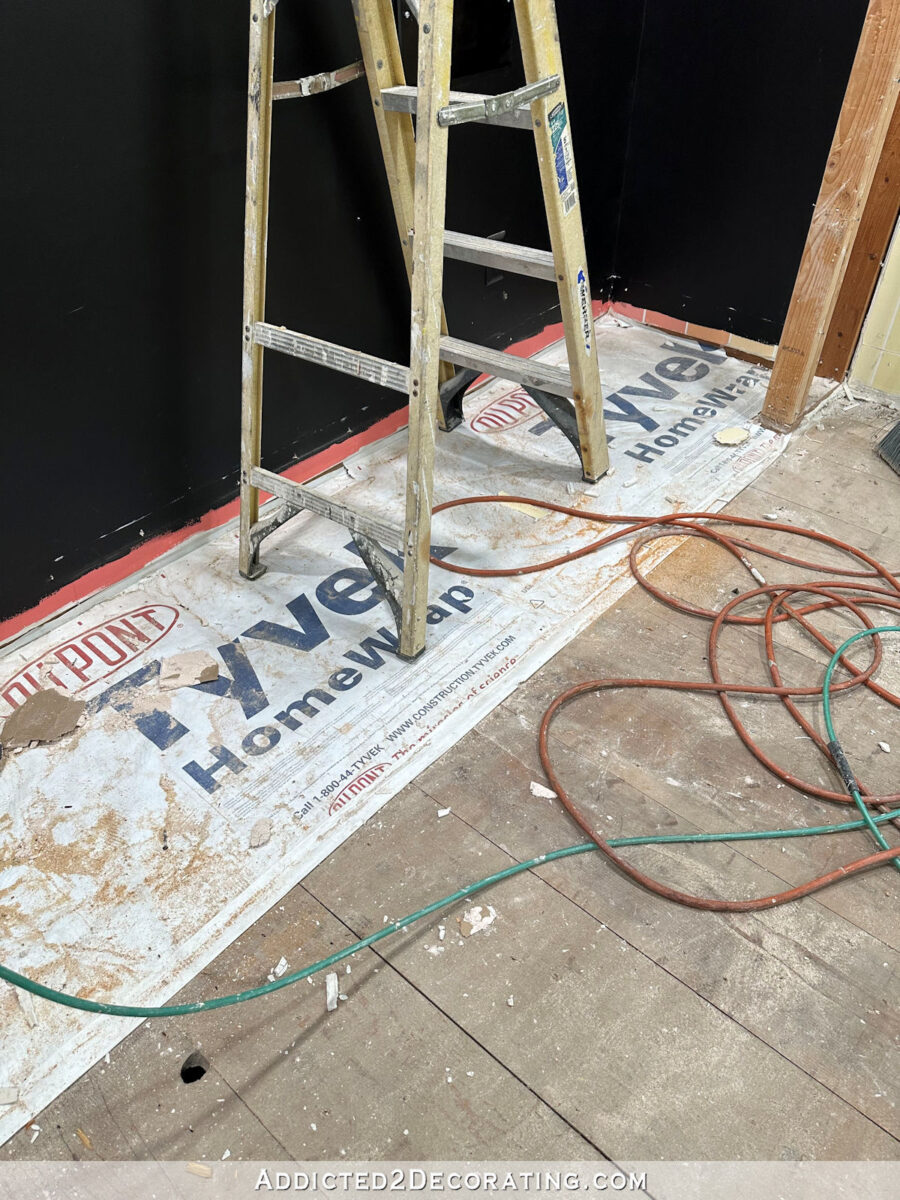
I was also very curious to see what the subfloor would look like under that one floor board that seemed to be deteriorating over time. This floor board was such a mystery to me. It wasn’t termite damage. There’s no evidence of any termite damage anywhere. So what was it? Water damage? Some sort of strange fungus? I don’t know what it was, but it was causing this one floor board to turn to dust.

I forgot to get a picture before they brought all of their tools in and placed them along that wall, but there was no damage to the subfloor under that board. I couldn’t believe it.
So after all of the flooring was taken up and cleared out of the room, I had a few minutes when I doubted the plan to take up and replace the subfloor. No, this subfloor isn’t what’s used today, but this thing has withstood 76 years. And 76-year-old lumber is whole different thing from today’s lumber. It’s harder and stronger and just overall better.
But in the end, I decided to stick with the original plan and have the subfloor removed and replaced. I don’t like being wasteful, and I don’t like redoing things of this scale just for the sake of redoing them. (This goes far beyond just repainting a wall, and creates a whole lot more waste.) But my main reason for sticking with the plan is so that we can have an insulated floor.
Since this room is going to be our final and forever bedroom, I want it done right, and I want it to be as cozy as possible. So I need insulation under the floor, and the only way to do that is to take up the subfloor and replace it. Our crawl space is way too cramped to get insulation under there any other way.
And really, it would be nice to replace this lumber with all of the knot holes with something more solid.

This subfloor not only has lots of big knot holes, but it also has some pretty significant cracks.

Most of the cracks haven’t affected the integrity of the boards…yet. But I just don’t like the idea of having these big cracks in the subfloor. This one in particular runs right through the middle of the room.

There’s really only one area where a crack has compromised the integrity of the board, and it just happens to be right here at the doorway to the bathroom. So that’s not good at all. I can actually feel it give a little bit when step on it, and it no longer sits flush with the board next to it.

So in the end, I decided to keep with the original plan and have it all replaced so that we can have a cozy insulated floor and a more solid subfloor without cracks or knot holes. I think that once winter gets here, I’ll be glad I decided to stick with that plan.


Addicted 2 Decorating is where I share my DIY and decorating journey as I remodel and decorate the 1948 fixer upper that my husband, Matt, and I bought in 2013. Matt has M.S. and is unable to do physical work, so I do the majority of the work on the house by myself. You can learn more about me here.
I love old wood; you are right that it is so much better than the stuff we have today. When my in-laws house burnt in 2008, it did not burn down because it was 250 years old. My brother-in-law is a contractor and had his parents back in their home in 10 months. He gave us some of the original boards, 40″ wide pine, that now graces our over mantel for our woodstove. You just can go to Home Depot and ask the guy for the super old wide boards anymore. Is there a way you save some of the boards for some other projects? Once through the planer and joiner, I can see you building something for the house that will be a treasure for years.
Everything looks really good and can’t wait for the next step. Sending you lots of patience to have part of your house tore up again. I just put a project to bed and am not too excited to rip open the guest bath next. Just a few weeks without plaster dust and workmen would be a vacation.
Remember slow and steady wins the race.
Cheers!
I was going to say the same thing… save that wood! 🙂
I’m curious if any of the knot holes and cracks lined up where the damaged boards were, allowing moisture to come up through those areas.
That’s my wonder too.. And those carpet tiles being a great moisture blocker on top, but not so much below…
Reading this to my carpenter husband and he agrees with your plan, especially getting the floor insulated.
I remember when you were fixing the hardwood floor and that area of rotten wood came up. When you just now mentioned the powdery stuff, we had a similar issue with brand new lumber we had delivered to our build site. We had some leftover 12 ft. 2×6’s, covered for winter, we believe that that lumber came with carpenter ants. We were shocked how much damage they did in such a short time. Between the stacked lumber was nothing but powder. It took us forever moving every piece and destroying them.
Not termites, but carpenter ants in our situation.
Hi Kristi! I’ve been following this saga with great interest. My question (which you don’t need to answer–I’m just scratching my curiosity itch) is: Shouldn’t there have been a moisture barrier UNDER the subfloor in the original structure (for the entire house), since there’s no basement and just a crawl space with bare earth? Or a vapor barrier over the dirt? I would think that even 75 years ago that would have been standard practice. Anyway, I’m waiting for the next installment!
I’m thinking the same thing: it wasn’t a code requirement to have vapor barrier in crawl spaces below the subfloor 75 years ago, but it would be a standard practice today to install vapor barrier over the dirt in the crawl space under a house like this. It wouldn’t be a bad idea to do it now, but the house has held up fine without it for decades so unless current code absolutely requires it to pass inspection, it might not be cost effective for a risk/benefit analysis.
When we bought our little lake cabin in ‘15, the previous owners had these random little rugs all over the place. We realized there was no insulation under the floors. Thankfully, there was a huge crawl space, so I put Roxul insulation between the floor joists. It made such a huge difference! No more little random rugs!
Kristi…I think you are doing the very best thing by sticking to the original plan and replacing the sub floor. Getting everything done to ensure a moisture barrier and an insulated floor without any knot holes will ease your mind about any future ‘uh ohhhs”.
I certainly agree with you about the grade of the old 76 year old lumber sub floor being better than today’s lumber grade. This lumber could be planed and used for wonderful projects if one wanted. But, I’m glad you are moving on to completely all new updated floor and get your new bedroom going. I am looking forward to hearing what you and Matt think of spending your first night in your new bedroom decorated beyond beautiful by Kristi.
I agree: stick with the plan for a whole host of reasons, and try to repurpose as much of that undamaged old lumber as you can! You could create the most wonderful shelves out of those boards, build some terrific furniture, or sell lumber to woodworkers who specialize in creating one-of-a-kind furniture out of recycled lumber. Those boards are valuable and can’t be re-created today! I’ve seen some terrific furniture on line created out of recycled lumber like your subfloor.
The front closet wall looks load bearing How will you handle that now that the closet is being removed?
I think she added that closet when she made the gym. She had a post wondering whether or not to add it and felt at the time that it would be easier to convert into a bedroom down the road for resale. But this was when she wanted to add the addition off the master bath. I don’t think any of her bedrooms had closets since she also added the ones in the guest room (that they are now using as master until the gym is converted).
So, if the floor problems (hills, etc) wasn’t caused by the sub-floor, what *did* cause it?
Your old floor boards would look great as wall decoration in your workshop. Not many people have 76 year old wood to make something out of.